




Top 19 Most Common Insects in Kilimanjaro
Insects, those invertebrates adorned with exoskeletons and diverse features, reside voluptuously in Kilimanjaro. Their population varies across its distinct landscapes, a testament to Kilimanjaro's geographical richness. These minuscule wonders play a vital role—if often misunderstood—in our ecosystem. From beneficial pollinators to bothersome pests, Kilimanjaro's veritable insect kingdom mirrors its environmental diversity. Ready to meet the 19 most common insects found in Kilimanjaro? They are much more remarkable than you might imagine.

Most Common Insects
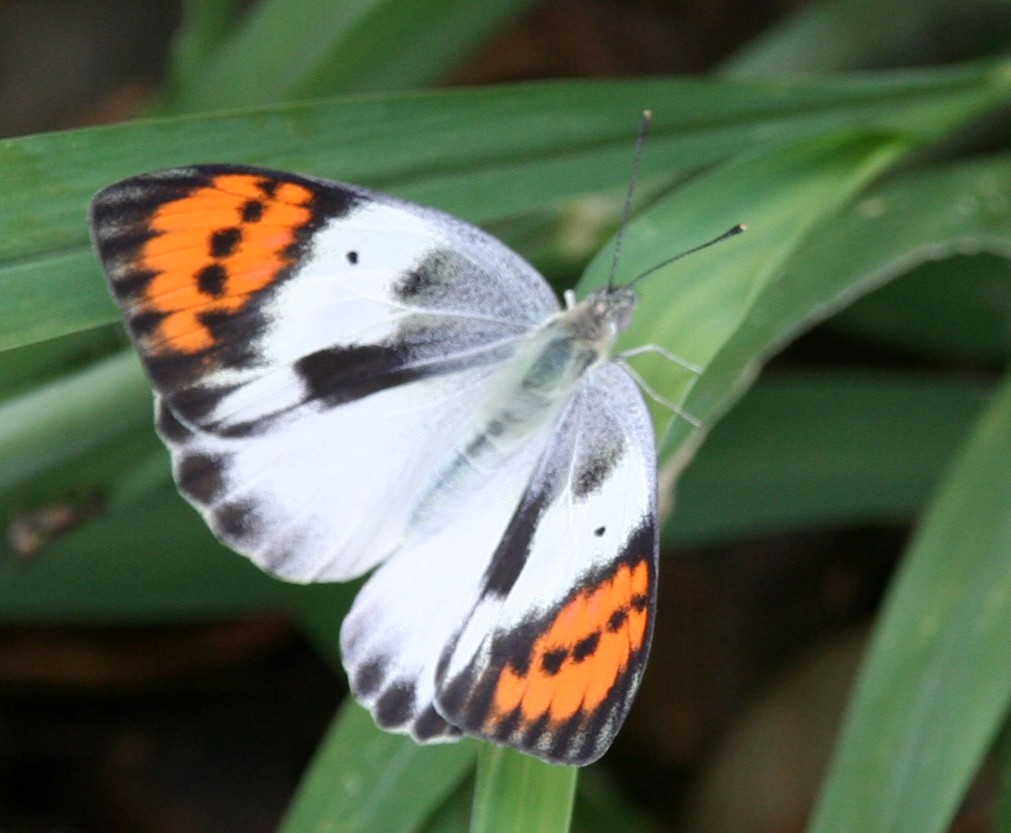
1. Common purple tip
Colotis ione, the bushveld purple tip, common purple tip, or violet tip, is a butterfly of the family Pieridae. It is found in the dry parts of Africa south of the Sahara. The wingspan is 45–52 mm. The larva feed on Maerua, Boscia, Capparis, Ritchiea, and Cadaba species. 
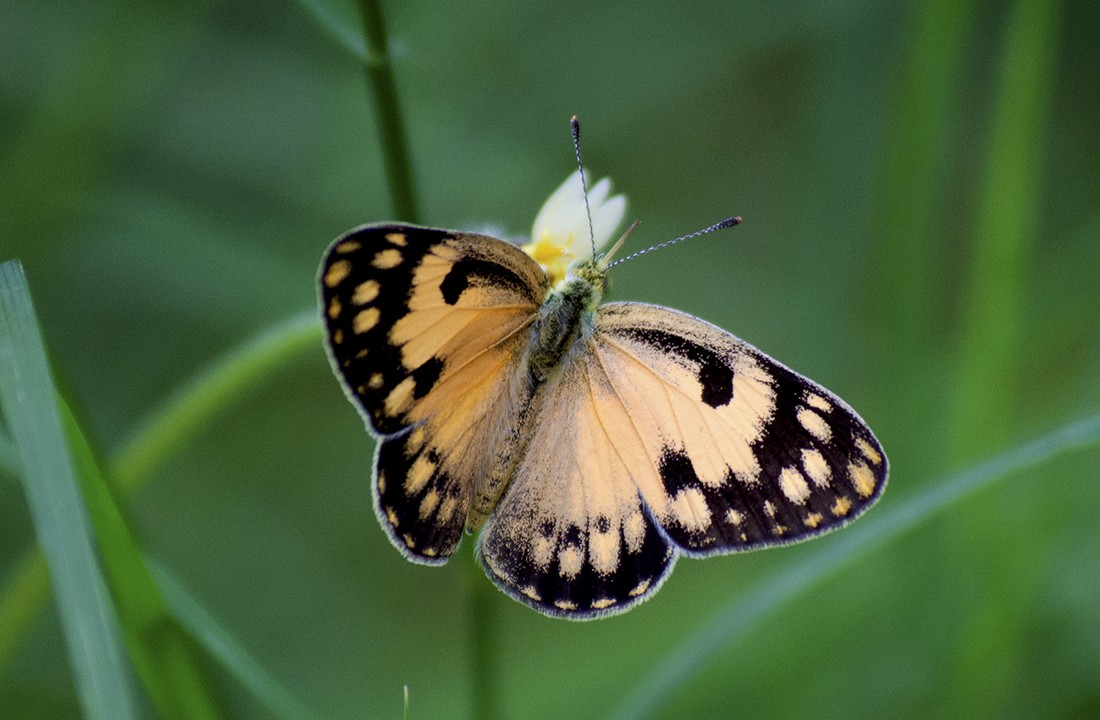
2. Small salmon arab
Male upperside has a salmon-pink ground colour. The costa on the forewing is black and thickly overlaid with greyish or pinkish scales; a black spot at apex of cell, which may be large and quadrate or smaller and lunate; the spots in the outer series are variable in number, but generally there is one in each interspace, these are more or less linear in shape. Hindwing: a band on costal margin extended to just within the upper margin of the cell, covered with dense black specialized scales; this black band joined onto a broad similarly-coloured terminal band of ordinary scales, that becomes more or less diffuse and powdery posteriorly, and encloses a double series of small spots of the ground colour the inner series often obsolescent, in some specimens entirely absent; dorsum heavily irrorated with fuscous scales, the irroration extended onto the disc, which has therefore generally a greyish appearance. Underside: greenish yellow; an anteciliary fine black line on both forewing and hindwings; the black markings of the upperside show through by transparency. Forewing: a black spot, variable in size and intensity, in some specimens absent altogether, at apex of cell; disc faintly, dorsal margin broadly very pale salmon pink. Hindwing: the whole surface sparsely irrorated with minute black scales; a small black discocellular spot. Cilia of both forewings and hindwings pale salmon pink. Antennae, head, thorax and abdomen black, the antennae speckled with white, the head and thorax covered with greenish-fuscous hairs; beneath: the palpi green, thorax and abdomen white. Female is polymorphic. Upperside: ground colour paler than in the male, in some specimens quite ochraceous outwardly; all the markings similar, but duller in tint. The hindwing, of course, without the black costal band of specialized scales, the ground colour extended up to the costal margin. Underside similar to that of the male, but the ground colour very much paler and more ochraceous than green.

3. Citrus swallowtail
Papilio demodocus , also known under the English name Citrus Swallowtail ("Citrus Swallowtail"), is a butterfly from the family of the knight butterflies (Papilionidae).
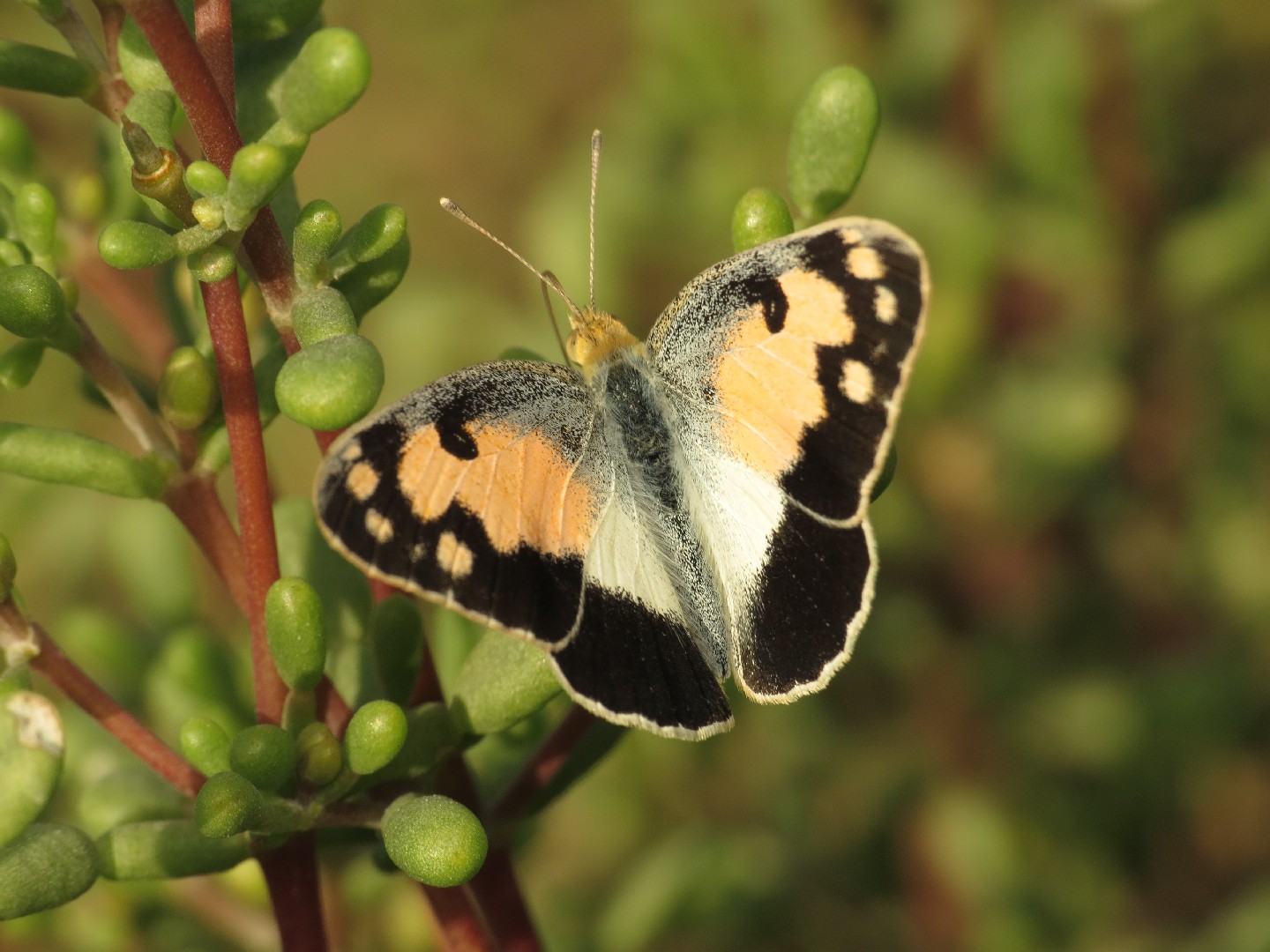
4. Blue-spotted arab
Upperside of male forewing has a pale salmon-pink ground colour, this colour paler outwardly; base heavily irrorated (sprinkled) with bluish-grey scales that extend outwards and are merged with a black patch that occupies the apex of the cell and spreads along the discocellulars; terminal third of wing black with enclosed spots of the ground colour in interspaces 3, 4, 5 and 9, the spot in 4 sometimes absent, the inner edge of the black area emarginate at interspaces 2 and 4; the outer margin with a series of minute terminal specks of ground colour in the interspaces. Hindwing: white, base heavily irrorated with bluish-grey scales that are extended downwards in a diffuse band parallel to the dorsum; terminal half of wing jet black. Underside: precisely like the underside of C. protractus male. Antennae, head, thorax and abdomen as in C. protractus. Female is very variable, but resembles the male in markings. On the upperside however, the terminal areas on both forewings and hindwings that are black in the male are silky brown on the forewing, the inner sinuate margin of the same posteriorly black; on the hindwing the terminal brown area encloses an irregular sinuate black band that does not extend either to the costa or the dorsum. The ground colour of the forewing in some specimens is faintly pink fading to white outwardly; on the hindwing the ground colour is white, as in the male. In other specimens the ground colour on both forewings and hindwings is entirely white or pinkish orange. Underside: as in the male, but the apical area of the forewing and the whole surface of the hindwing tinged more or less with ochraceous. In many individuals (probably of the dry-season broods) this ochraceous tint is very marked. Forewing: with posterior black spots as in the male. Hindwing: an irregular discal sinuate macular brown band that is often obsolescent. Antennae, head, thorax and abdomen much as in the male.
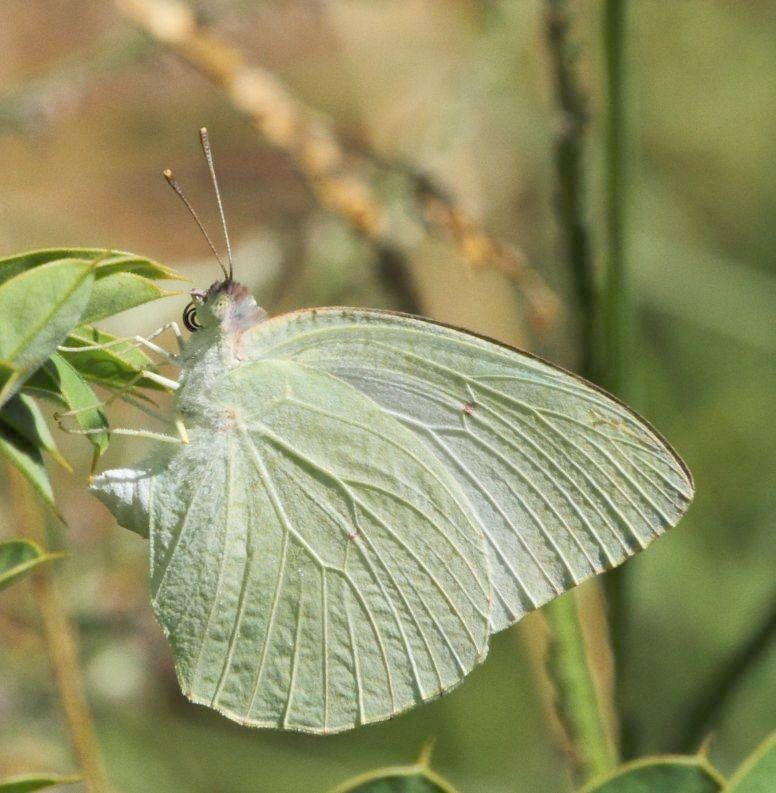
5. African emigrant
The wingspan is 5 - 6 cm for males and 6 - 7 cm for females.

6. Tiny grass blue
Male upperside is dull violet blue, which changes to a brighter tint of violet in certain lights. Forewing: the costa very narrowly, the termen much more broadly dull brown; this edging to the termen in most specimens decreases in width from apex to tornus, and is outwardly followed by an anteciliary darker brown line. Cilia brownish anteriorly, posteriorly brownish at the base with the apical portions white. Hindwing: the ground colour brighter than on the forewing, the costal and terminal margins much more narrowly edged with brown, which edging is merged in the anteciliary dark brown line. Cilia: brown along their basal halves, white apically. Underside: grey. Forewing: a dusky brown lunular line on the discocellulars; two subcostal spots above the cell, one on either side of the discocellular lunule; a very strongly curved discal series of five spots, of which the posterior three are somewhat lunular in shape and placed obliquely en echelon, the next above these hook shaped, the anterior spot round; both the subcostal spots and the spots of the discal series are black, each narrowly encircled with white; beyond these are inner and outer subterminal dusky lines, which anteriorly are continuous, posteriorly somewhat broken and macular, followed by a very conspicuous jet-black anteciliary slender line. Cilia greyish white, traversed by a medial transverse blackish-brown line. Hindwing: with the following small white-encircled black spots: a subbasal transverse series of three, followed by a highly curved series of eight spots, that curve across the disc of the wing to the costa and along the latter towards the base; discocellulars with a dusky short lunular line as on the forewing; terminal markings and cilia similar, but the outer and broader subterminal line more broken and macular than on the forewing. Antennae black, the shafts ringed with white; head, thorax and abdomen dark brown, with a little violet pubescence on the head and thorax; beneath: palpi, thorax and abdomen greyish white. Female upperside: glossy brown, without any violet tint whatever; the anteciliary darker brown lines on both forewings and hindwings well marked. Underside: very similar to that of the male, the ground colour a shade darker, the markings slightly larger and more prominent. Antenna, head, thorax and abdomen as in the male, but the latter three without a trace of violet or blue on the upperside.

7. Gold banded forester
The wingspan is 6 - 7 cm for males and 6 - 8 cm for females.

8. Blue pansy
The wingspan is 4 - 5 cm. The upper surface of the forewings is black with white markings towards the apex. The upper surface of the hindwings is black with white markings on the outer edge, and a characteristic large metallic-blue spot. This blue spot is smaller and more a dull purple in females. The underside of the forewings is brown with white markings corresponding to those on the upper surface. The under surface of the hindwings is almost uniform brown.
9. Pea blue
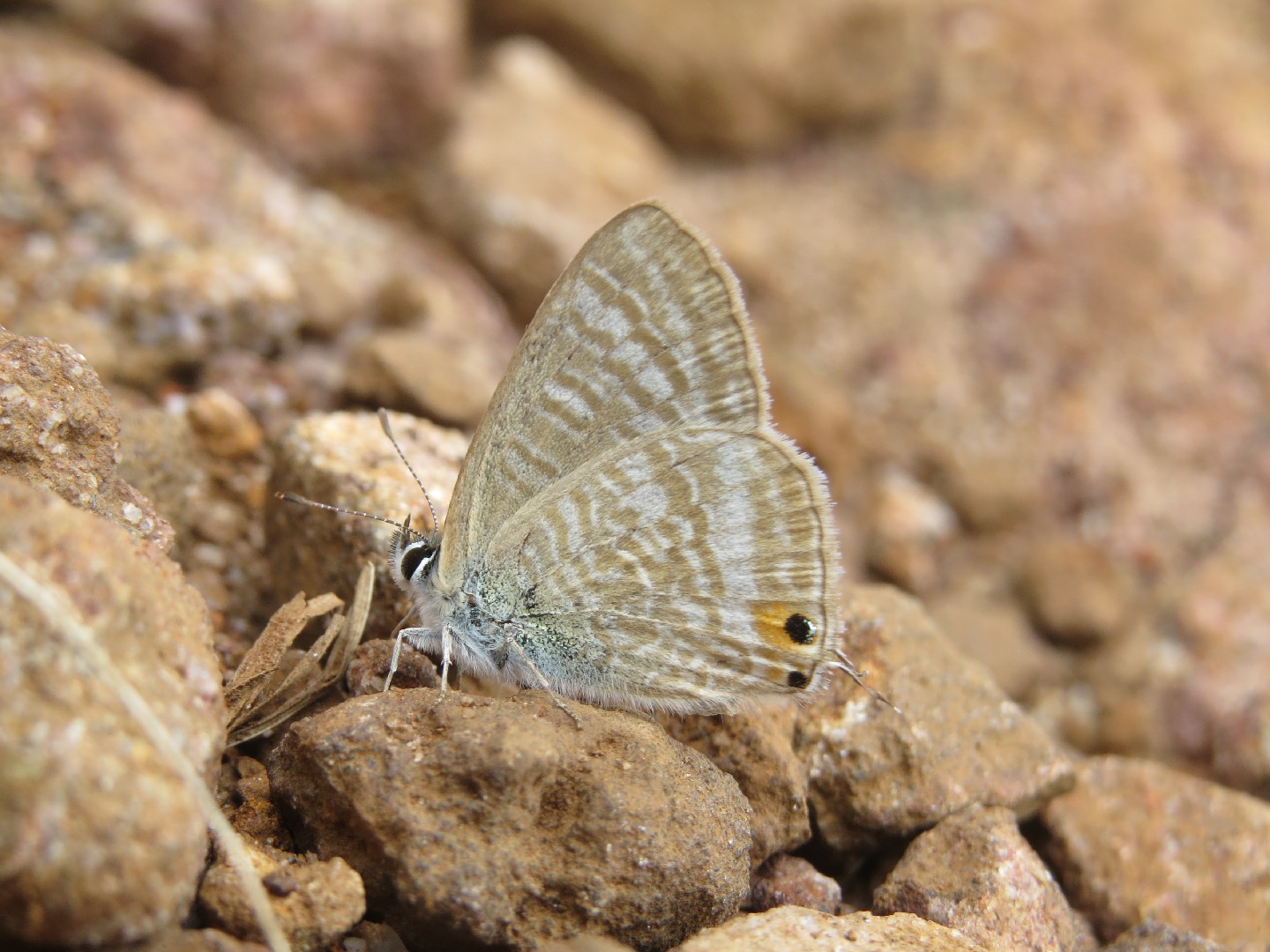
The wingspan is 24–32 mm for males and 24–34 mm for females. In these small butterflies the males have a mainly blue violet upper face of the wings with the brown edges, while the females have only a small amount of blue colour in the centre of the wings (sexual dimorphism). Both sexes have a thin, long tail in the hindwings and two black spots in the anal angle. The underface of the wings is ocher and adorned with white markings and with a larger white submarginal streak. The underface of each hindwing shows a pair of small black eye-spots beside each tail, with an orange marginal spots at the anal angle.

10. Dark grass blue
The wingspan is 1.8 - 2.5 cm for males and 2 - 2.5 cm for females.

More