




Top 20 Most Common Insects in Maharashtra
Welcome to the intriguing world of insects in Maharashtra, a state rich in entomological diversity due to its varied geography. From the soaring Western Ghats to the fertile plains, Maharashtra is a buzzing hub for insects playing vital roles in the ecosystem. We've curated the 'Top 20 Most Common Insects,' that span beneficial little helpers to pesky intruders, all contributing to the ecological balance in their unique way. Let's delve into these fascinating critters!

Most Common Insects

1. Common mormon
The common mormon (Papilio polytes) is a beautiful, black butterfly with unique hindwings that have orange and white colorings and two spots jutting out. They are named after the Mormon religion, as the butterflies participate in polygamy, which is a common practice for Mormons. They are also known to mimic red-bodied swallowtail, who are inedible.
2. Common emigrant
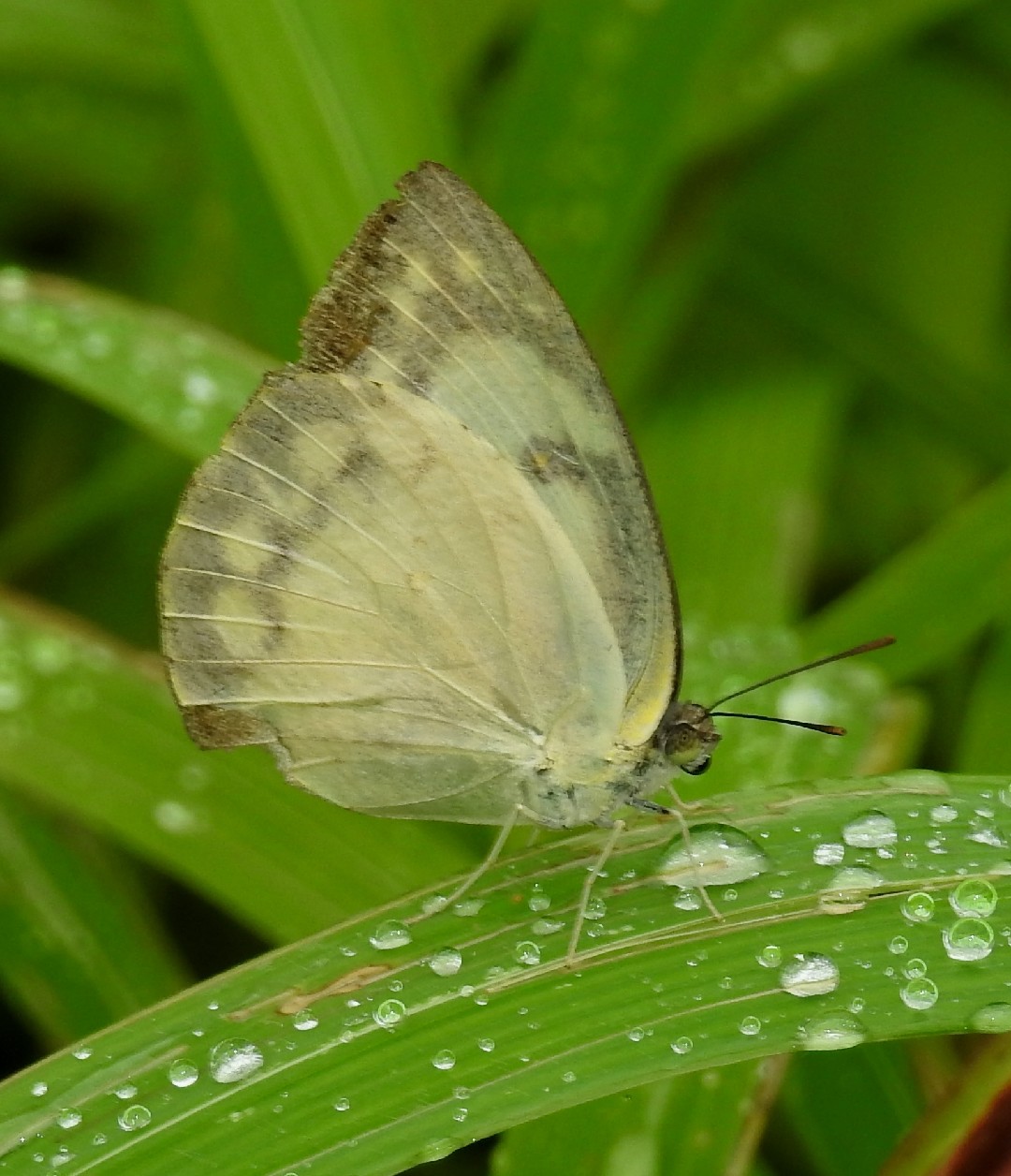
Male. "The upperside of the male is chalky-white, sometimes with a more or less broad and clearly defined basal sulphur-yellow area on both fore and hind wings; this sulphur-yellow colour is at times diffused over the whole surface of the wings, though generally it becomes paler towards the terminal margins. For the fore wing, the whole, or sometimes only the apical half, of the costa narrowly black, this color widened out irregularly at the apex; termen widely black at the apex, the colour narrowed posteriorly. This border in some specimens almost reaches the tornus, in others terminates above vein 4; occasionally it is continued posteriorly by a series of block dots at the apices of the veins. The Hind wing generally are uniform, unmarked, and some specimens bear minute black dots at the apices of the veins. "On the underside the groundcolour is very variable, with white with a slight to strong ochraceous tinge, greenish white or sulphur-yellow. The fore wing is typically without markings, in some specimens with a patch of sulphur-yellow on either side of base of median nervure, in the very yellow examples the tornal area is often widely greenish white, in others (Catopsilia catilla, Cramer) it bears a spot variable in size on the discocellulars. This spot has a pearly centre and an outer reddish line. Many specimens have an irregular angulated narrow discal reddish line (the colour varies in intensity) that runs from the costa obliquely outwards to vein 7, and then obliquely inwards to vein 2, though this line is often absent in specimens that bear the discocellular spot; apex and termen sometimes very narrowly reddish. The hind wing is typically uniform, without markings." Female. "On the female upperside the ground-color varies as in the male, but sometimes it is chalky white at the bases of the wings, with the terminal margins more or less broadly sulphur-yellow. Fore wings always with a round, occasionally quadrate, black discocellular spot variable in size; in some specimens the costa is black only towards the apex of the wing, in others broadly black throughout and opposite the apex of cell so widened out as to touch the discocellular spot. In lightly marked specimens in addition to the discocellular spot, there is only an irregular terminal black band dentate inwardly and widest at the apex of the wing; in others there is in addition a more or less diffuse highly curved macular postdiscal band that extends from the costa obliquely outwards down to vein 7, where it often touches the terminal black band, and thence is continued downward and slightly inclined inwards to interspace 1, getting gradually paler and fainter posteriorly. Hind wing are a series of terminal inter-spacial black spots that vary in size, and in the dark forms coalesce into a terminal black band." 
3. Common grass yellow
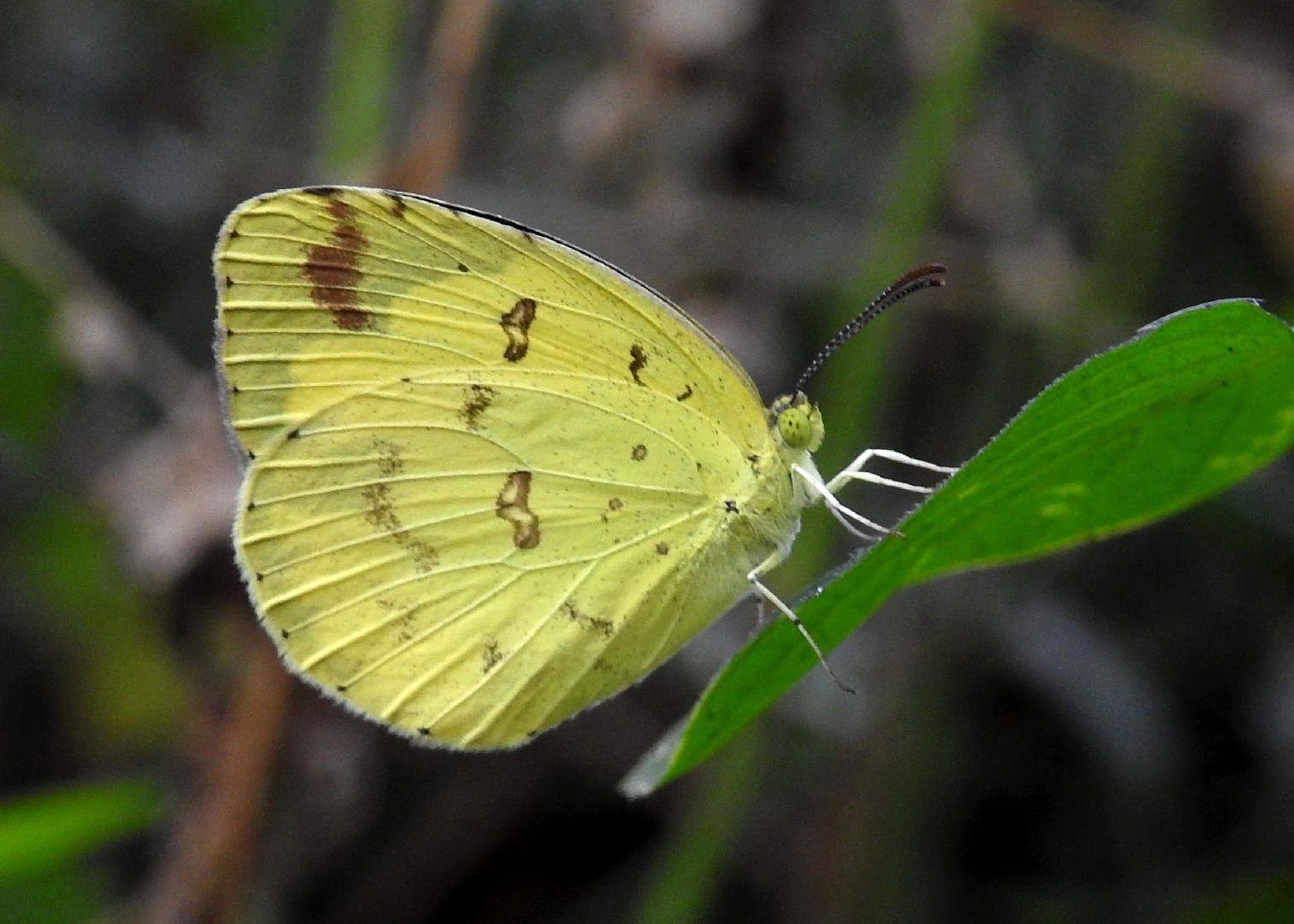
The common grass yellow (Eurema hecabe) can be found in groups around damp soil. Despite their name, they do not feed on grass, instead, they are known to frequently visit grasslands. It can change its form depending upon the season, as it is far more rough-looking if it comes during the dry season.
4. Plain tiger butterfly
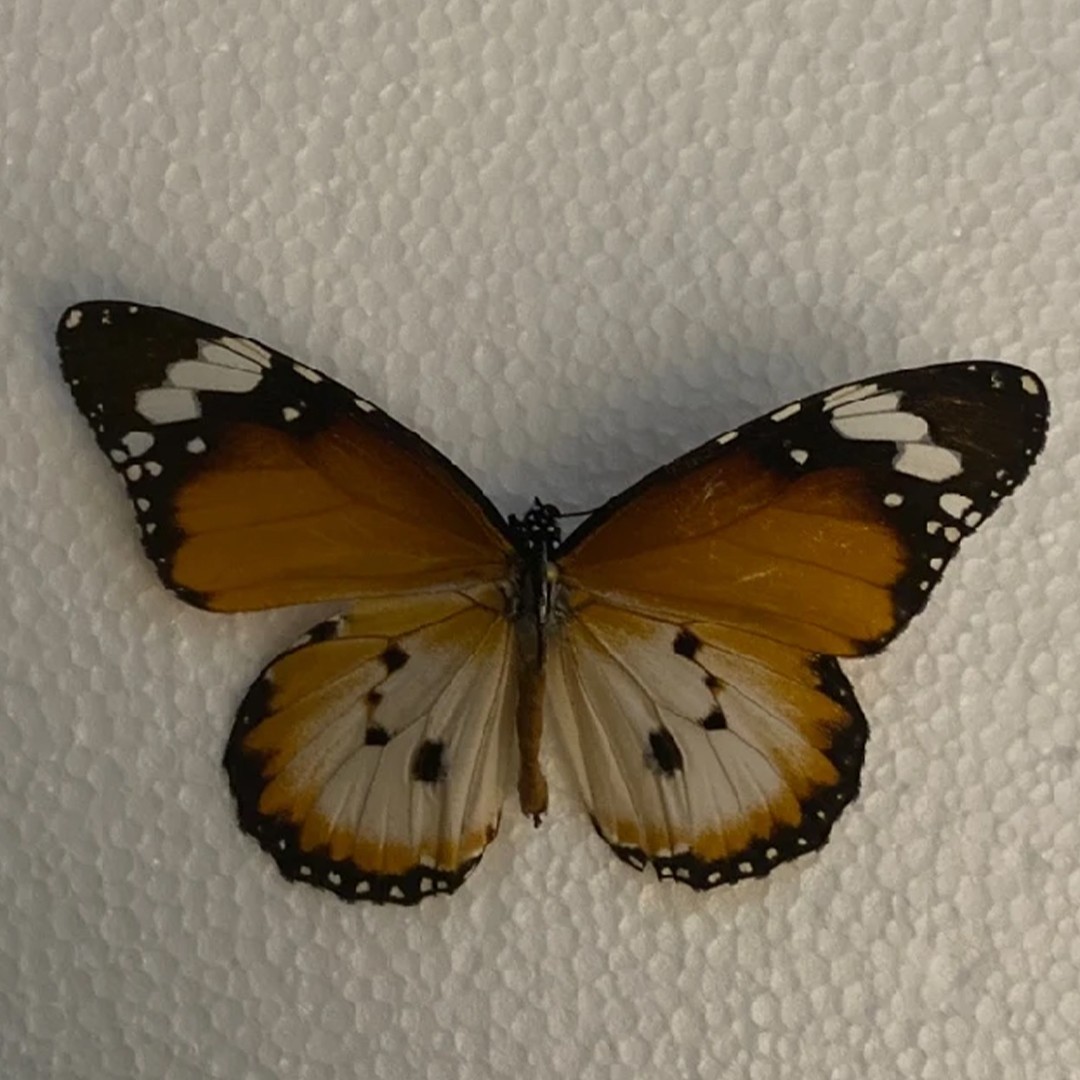
D. chrysippus is a medium-sized butterfly with a wingspan of about 7–8 cm (2.8–3.1 in). The body is black with many white spots. The wings are orange, the upperside brighter and richer than the underside. The apical half of the forewing is black with a white band. The hindwing has three black spots in the center. The wings are bordered in black and outlined with semicircular white spots. This species exhibits slight sexual dimorphism, as the Male has large scent glands on his hindwings, which the female lacks. They appear as a large black spot with a white centre if viewed from the underside D. chrysippus is a polymorphic species, so the exact coloring and patterning vary within and between populations. It is similar in appearance to the Indian fritillary (Argynnis hyperbius), which may coexist with it.

5. Blue moon butterfly
Hypolimnas bolina, the great eggfly, common eggfly or in New Zealand the blue moon butterfly is a species of nymphalid butterfly found from Madagascar to Asia and Australia.

6. Tiny grass blue
Male upperside is dull violet blue, which changes to a brighter tint of violet in certain lights. Forewing: the costa very narrowly, the termen much more broadly dull brown; this edging to the termen in most specimens decreases in width from apex to tornus, and is outwardly followed by an anteciliary darker brown line. Cilia brownish anteriorly, posteriorly brownish at the base with the apical portions white. Hindwing: the ground colour brighter than on the forewing, the costal and terminal margins much more narrowly edged with brown, which edging is merged in the anteciliary dark brown line. Cilia: brown along their basal halves, white apically. Underside: grey. Forewing: a dusky brown lunular line on the discocellulars; two subcostal spots above the cell, one on either side of the discocellular lunule; a very strongly curved discal series of five spots, of which the posterior three are somewhat lunular in shape and placed obliquely en echelon, the next above these hook shaped, the anterior spot round; both the subcostal spots and the spots of the discal series are black, each narrowly encircled with white; beyond these are inner and outer subterminal dusky lines, which anteriorly are continuous, posteriorly somewhat broken and macular, followed by a very conspicuous jet-black anteciliary slender line. Cilia greyish white, traversed by a medial transverse blackish-brown line. Hindwing: with the following small white-encircled black spots: a subbasal transverse series of three, followed by a highly curved series of eight spots, that curve across the disc of the wing to the costa and along the latter towards the base; discocellulars with a dusky short lunular line as on the forewing; terminal markings and cilia similar, but the outer and broader subterminal line more broken and macular than on the forewing. Antennae black, the shafts ringed with white; head, thorax and abdomen dark brown, with a little violet pubescence on the head and thorax; beneath: palpi, thorax and abdomen greyish white. Female upperside: glossy brown, without any violet tint whatever; the anteciliary darker brown lines on both forewings and hindwings well marked. Underside: very similar to that of the male, the ground colour a shade darker, the markings slightly larger and more prominent. Antenna, head, thorax and abdomen as in the male, but the latter three without a trace of violet or blue on the upperside.
7. Tailed jay butterfly
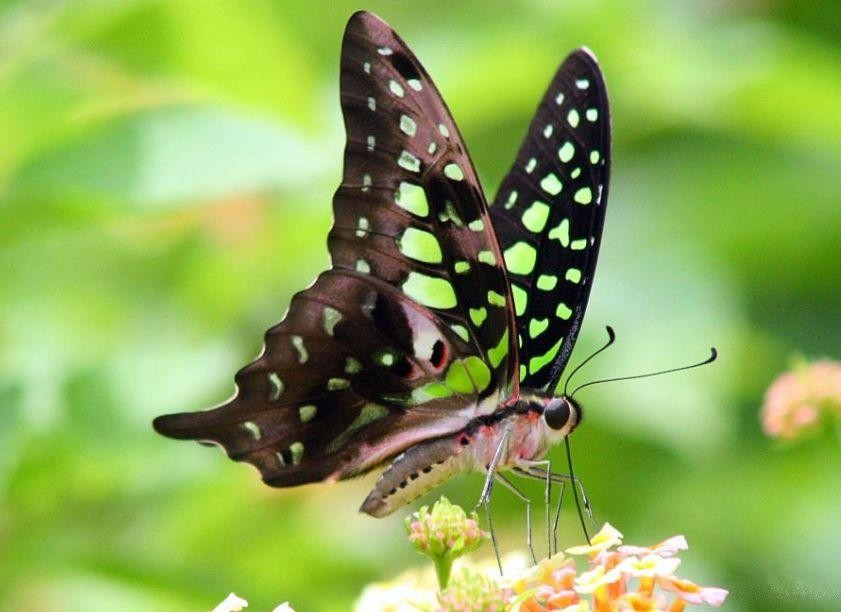
Male upperside is black. Forewing with the following green markings: a spot at the extreme base of the costal margin, a transverse short bar near base of cell and seven spots beyond, two and two except the apical spot which is single; two spots beyond apex of cell; a spot at base of interspaces 1a and 1, followed by two oblique short macular bands; a discal series of spots decreasing in size towards the costa, and a postdiscal series of smaller spots that begins with two in interspace 1; the spots in interspace 7 in both series are out of line, placed outwards. The hindwing has three series of similarly-coloured markings that ran transversely across the wing more or less parallel to the dorsal margin, the upper markings (those in interspace 7) white; a short greenish stripe at the extreme base of the wing. The underside is fuliginous (sooty) brown or brownish black, more or less suffused with pink along the costal margin, on apical area and along the outer margin of the discal markings on the forewing, broadly along the dorsal and terminal margins and at base on interspaces 6 and 7 on the hindwing; markings similar to those on the upperside but less clearly defined and somewhat more grey in tint. Hindwing black, inwardly red-margined spots superposed on the pink area in interspaces 6 and 7. Cilia very narrow, pale pink. Antennae, head, thorax and abdomen black, thorax above and the abdomen on the sides streaked with greenish grey; beneath is ochreous grey touched on the thorax with pink. Female is similar, but with a streak of greenish white along the dorsal margin on both upper and undersides.
8. Common evening brown
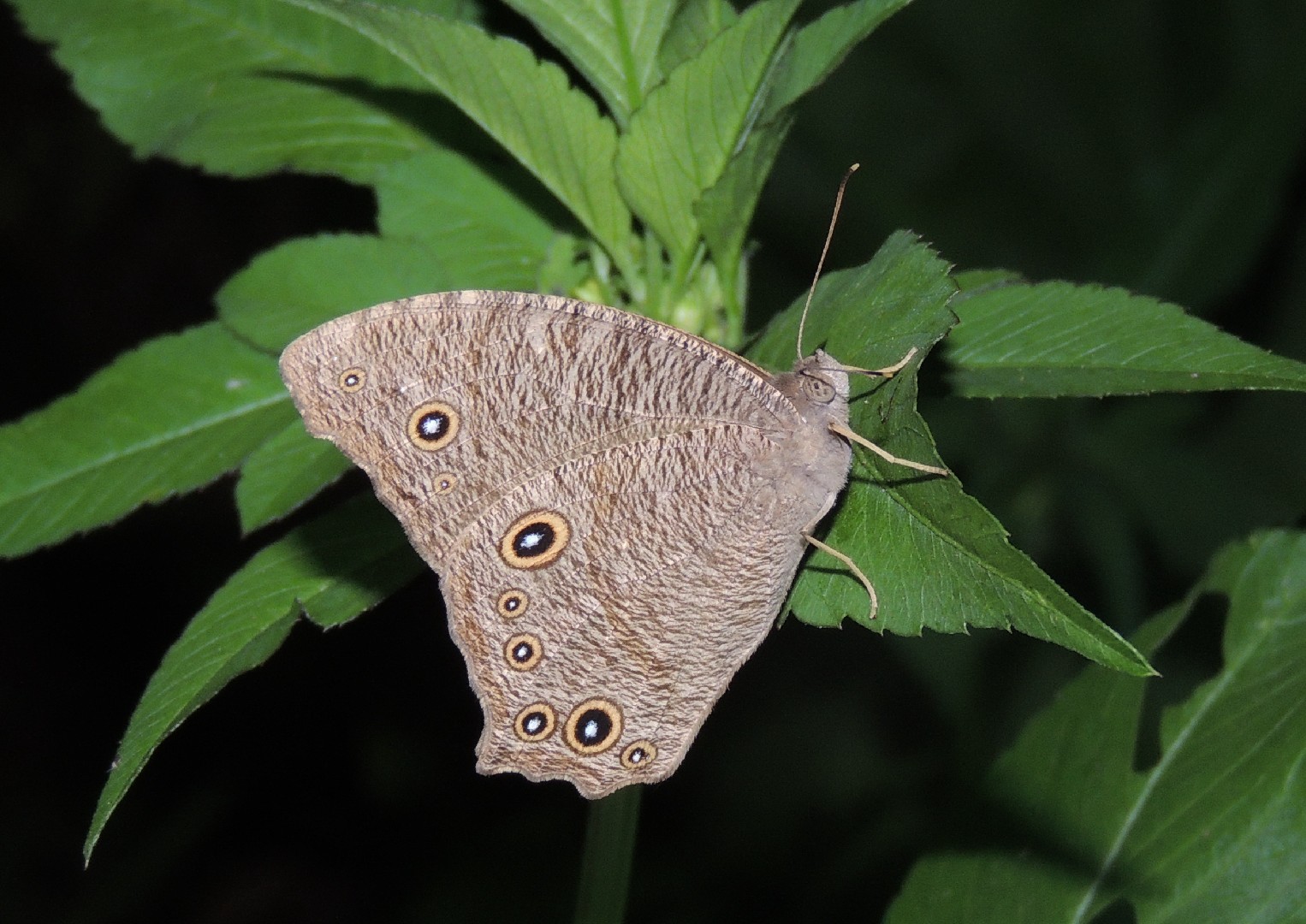
The common evening brown (Melanitis leda) changes its appearance based on the season. During wet seasons, it has a pale brown underside and a dark brown top. Then, during dry seasons, it often has more distinguished bands or spots. It uses these neutral colors to help it blend into leaves and trees. It usually only flies during the evening, resting during daylight.
9. Tailless line blue
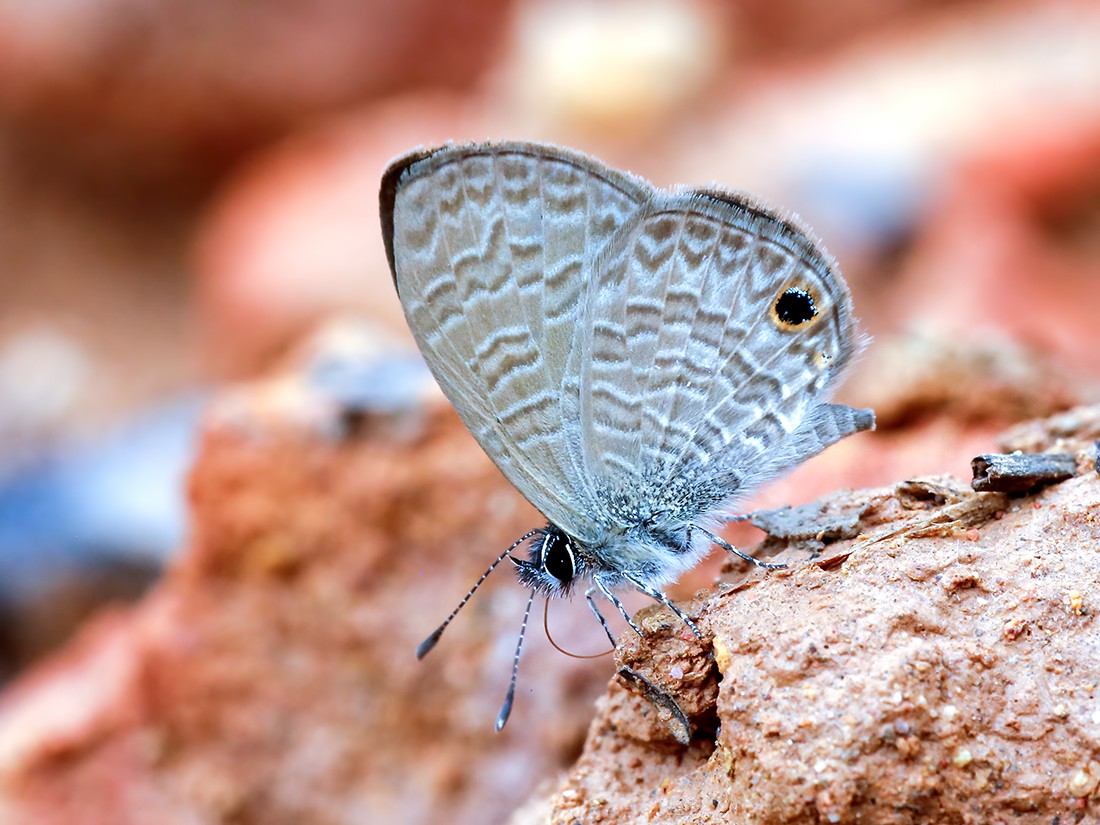
Prosotas dubiosa is a butterfly from the Lycaenidae family. The scientific name of the species was first validly published in 1879 by Semper.
10. Common crow
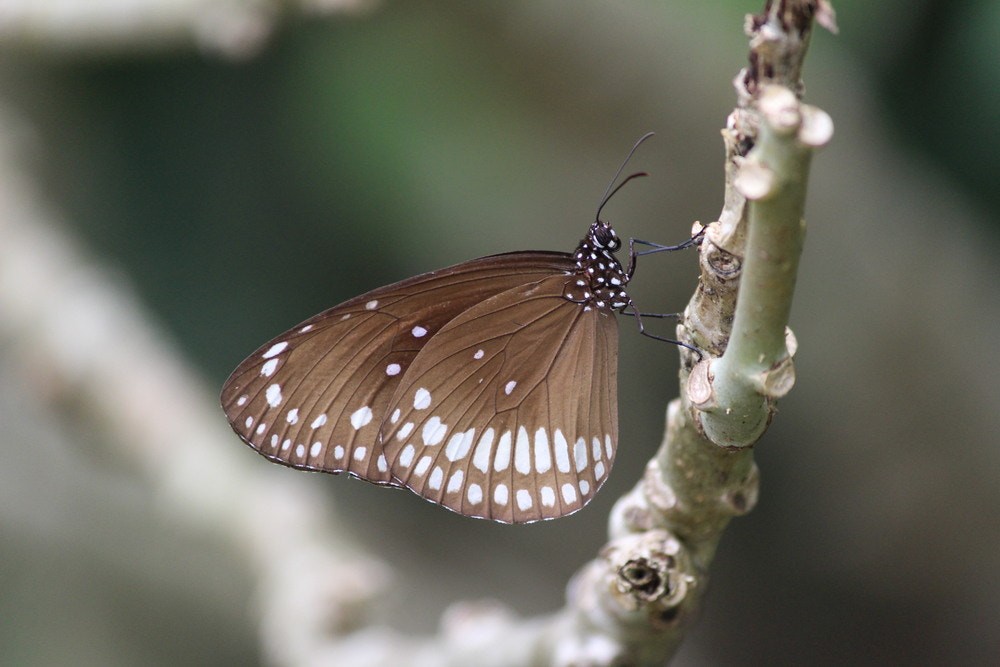
The common crow is a glossy-black butterfly with brown undersides with white markings along the outer margins of both wings. The wingspan is about 8–9 cm and the body has prominent white spots. The male has a velvety black brand located near the rear edge on the upperside of the forewing. On the underside there is a white streak in the same location. This white streak is present in both male and female. Upperside dark brown, broadly paler along terminal margins; Fore and hind wing with subterminal and terminal series of white spots; on fore wing the former more or less oval, curved inwards opposite apex, the latter series often incomplete, not reaching apex, the spots smaller; often there is a small costal spot, and very rarely a spot in apex of cell and one or more discal spots; on the hind wing the inner series of spots are elongate, the outer conical.Underside similar, but ground-colour more uniform; cell, costal and discal spots on both fore and hind wing nearly always present.


More







