




Top 16 Most Common Insects in Manado
Insects, with their intricate life cycles and diverse habitats, find unique niches within Manado's varied topography. The geography of Manado significantly influences insect biodiversity, creating a host of species playing an array of ecological roles- from pests to pollinators. Our list of the 'Top 16 most common insects' underscores the symbiotic relationship between this region's environments and its insect inhabitants.

Most Common Insects
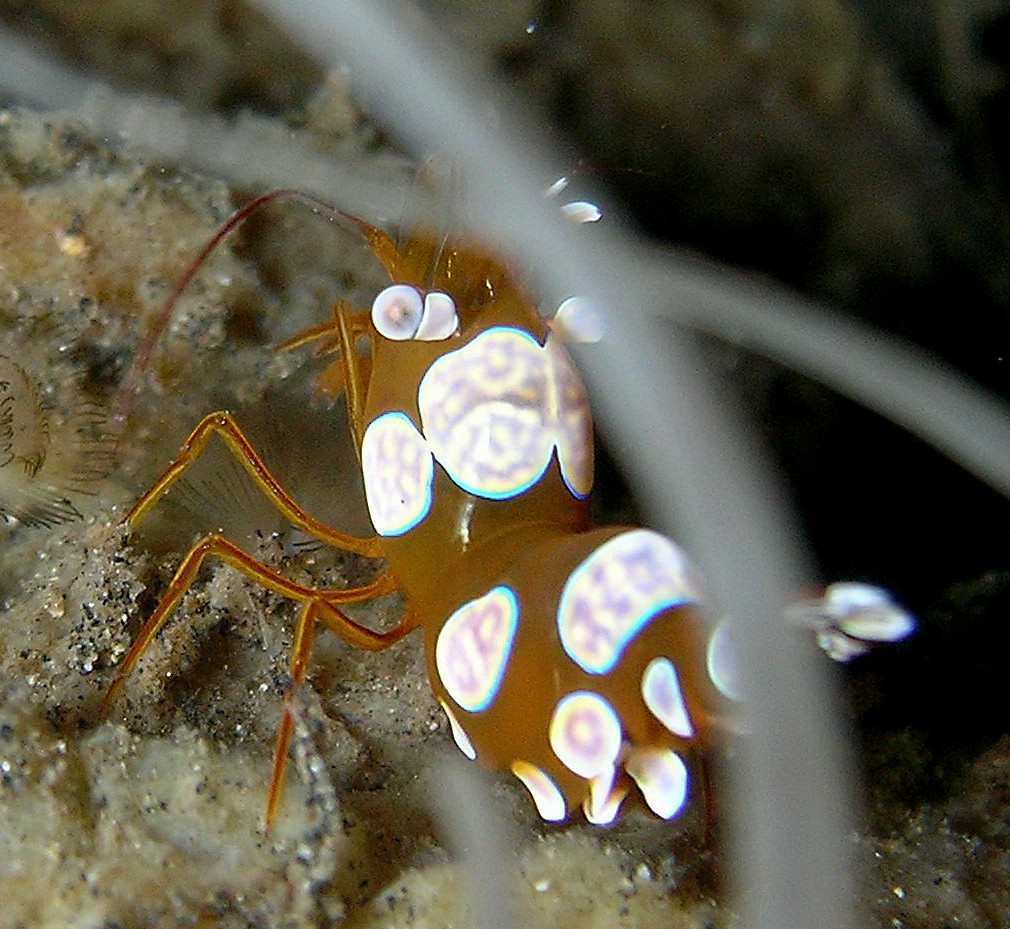
1. Squat shrimp
Thor amboinensis is a small shrimp growing to a length of about 13 millimetres (0.5 in). It is an olive brown colour with symmetrically placed white patches edged with thin blue lines. It characteristically carries its abdomen curved upwards with its tail fan above its head. 

2. Banded coral shrimp
Banded coral shrimp (Stenopus hispidus) is a crustacean that occupies tropical waters in the Atlantic Ocean, the Gulf of Mexico, and reefs surrounding Australia and New Zealand. It acts as a cleaner fish, and removing parasites and fungi from other passing fish. This species is monogamous and mates for life.
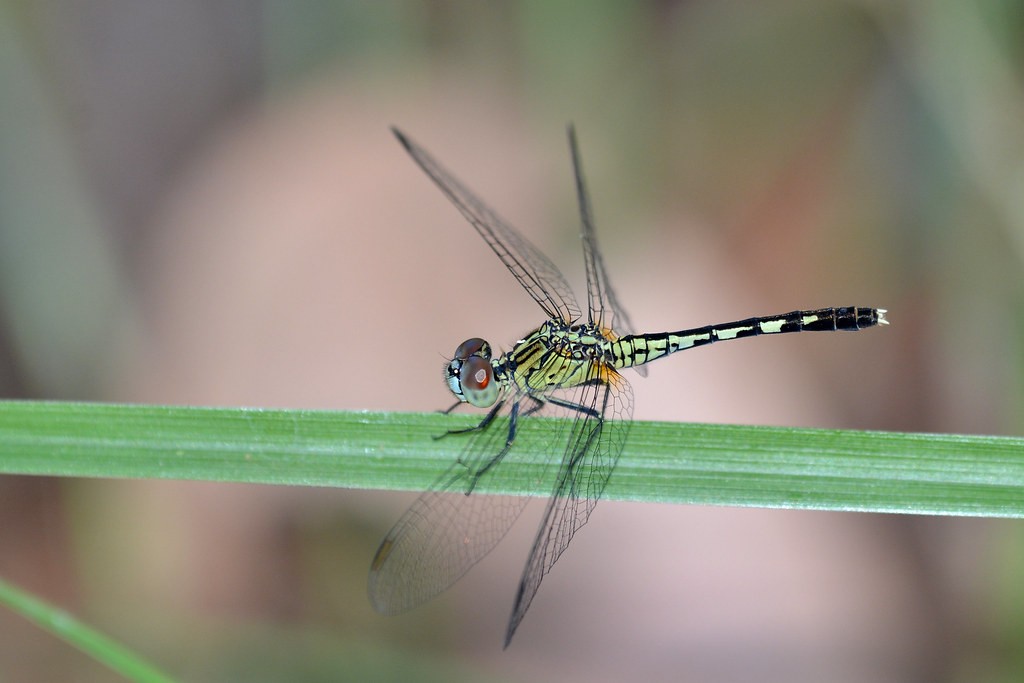
3. Green skimmer
Orthetrum serapia is a medium-sized dragonfly with a wingspan of 60-85mm. Its wings are clear except for a small dark spot at the base of the hindwing. The thorax is greenish to greyish yellow with black markings. The abdomen is black with pale yellow or pale green markings. Orthetrum serapia appears very similar to Orthetrum sabina and can be confused where the range of the two overlap in north-eastern Australia.
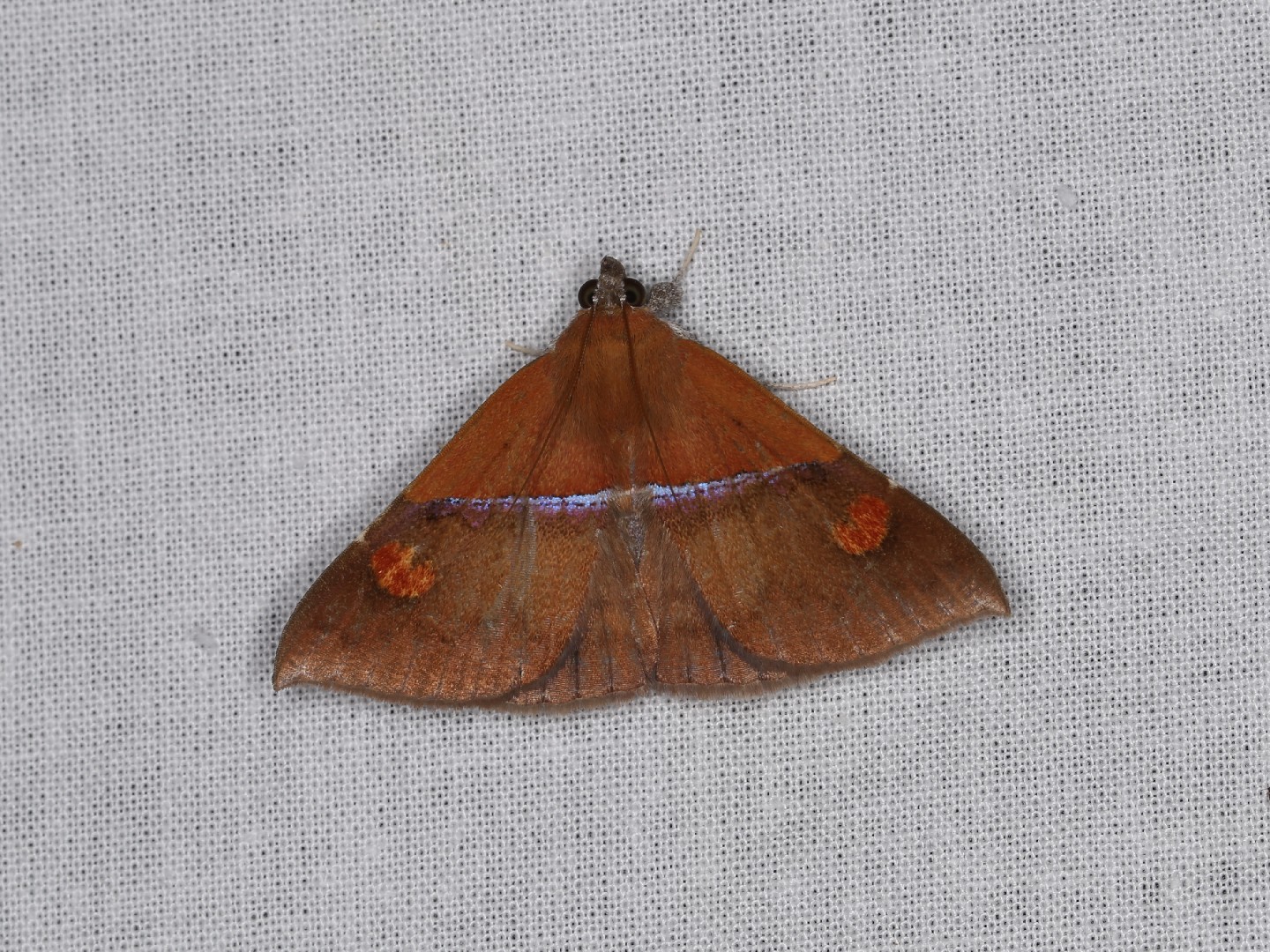
4. Sympis rufibasis
Its wingspan is 5 - 5 cm. The male has an orange-red head and thorax. Abdomen reddish brown. Forewings with orange-red basal area, bounded by an oblique blue line. The outer area reddish brown with a large scarlet lunule beyond the cell and a white speck on the costa above it. An indistinct, irregularly dentate, sub-marginal line and a marginal specks series present. Hindwings fuscous with incomplete medial white band and waved marginal line. Ventral side almost entirely grey suffused. A crenulate postmedial line present. Female lack scarlet lunule on forewings. Larva darkish, olive green brown with a distinct pale yellow stripe which runs along each side and extends from the head to the anal prolegs.
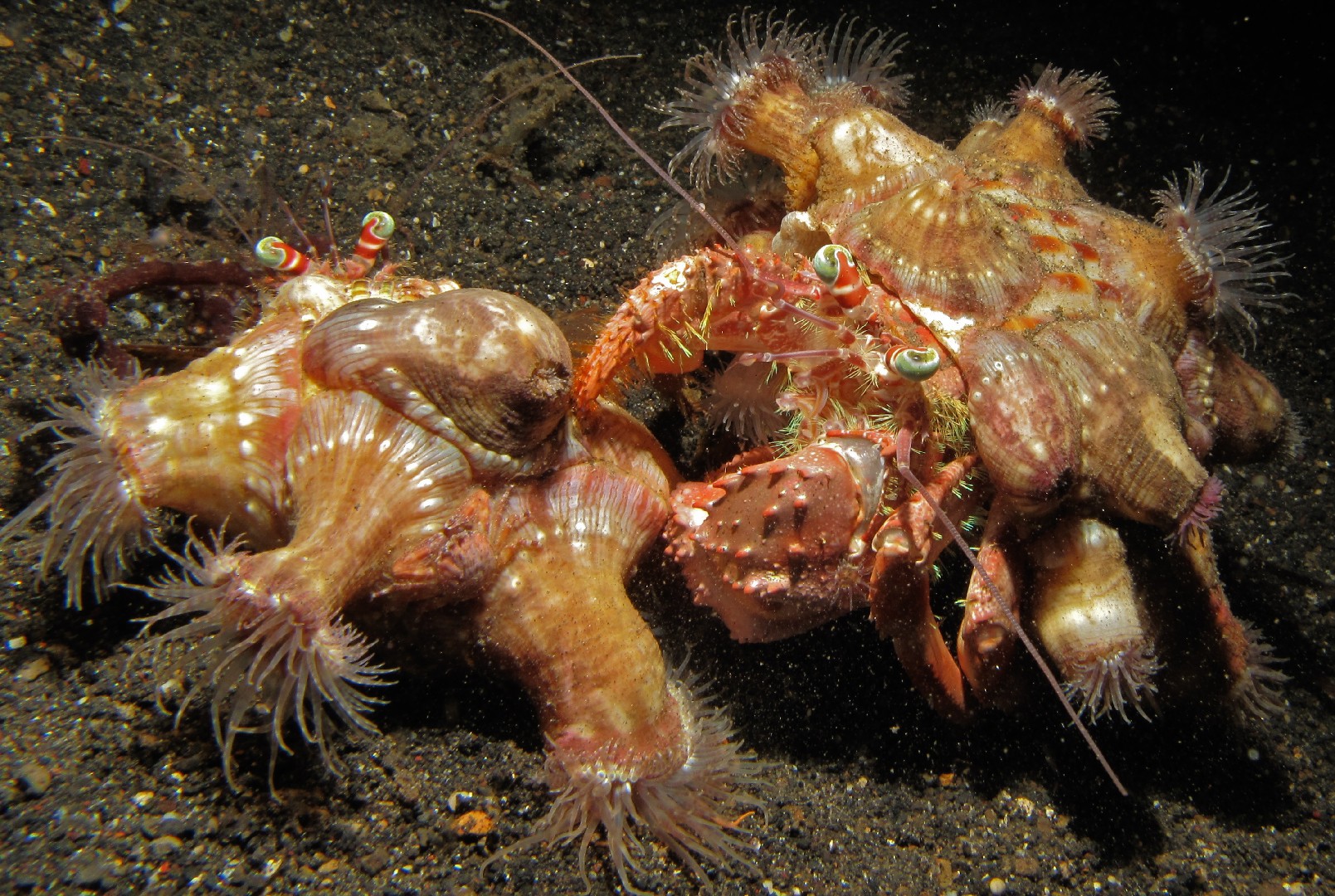
5. Anemone hermit crab
Dardanus pedunculatus usually attain a maximum size of 10 centimetres (4 in). The carapace is mottled in tan and cream, while the eyestalks are white with red bands. The sexes are similar. The left claw is much larger than the right claw.
6. Palm king
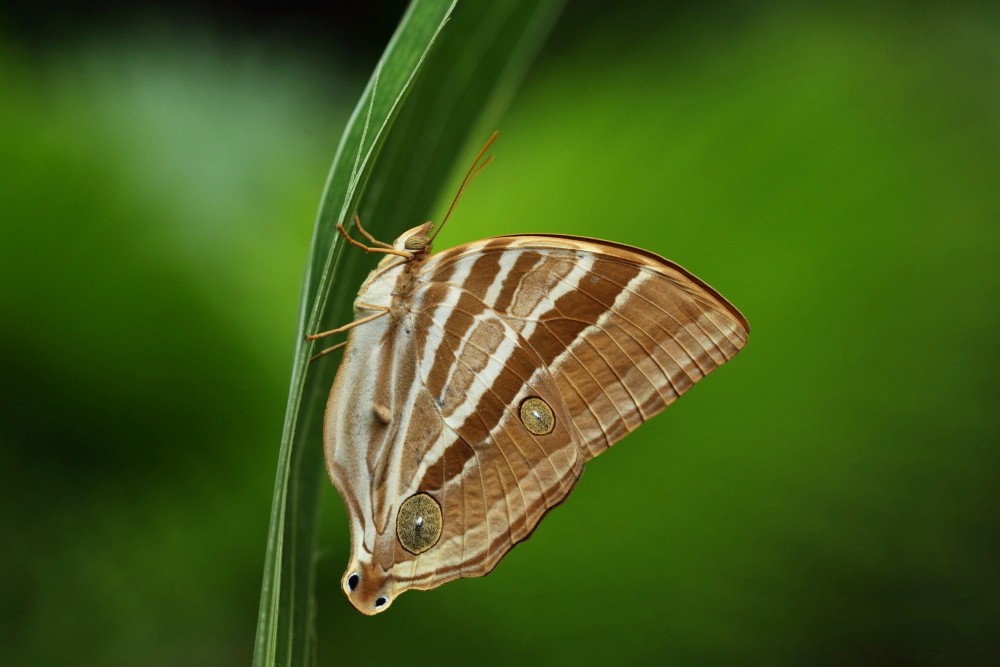
Male: upperside umber brown. Forewing with the costal margin narrowly fulvous (reddish brown) near apex, crossing towards the termen, forming an obscure preapical band joining a subterminal lunular band of the same colour. Hindwing uniform, with a subterminal band as in the forewing but not lunular, straight. Underside pale brown, with the following transverse pale lilac-white bands crossing both forewing and hindwing: basal, subbasal, discal, postdiscal, broad subterminal and terminal; the subbasal and discal of equal width, meeting above the tornal angle in V-shape, the space between the two bands with, on the forewing, two shorter similar bands crossing the cell, on the hindwing a single similar band from costa to median vein; subterminal band on hindwing bent upwards above tornal area and continued halfway up the dorsal margin, the broadly-produced tornus with a dark brown spot; finally a large ochraceous ocellus in interspace 2, and a smaller similar one in interspace 6. Antennae reddish; head, thorax and abdomen umber brown. Secondary sex-mark a glandular fold in membrane of wing shaded by tufts of long hair along vein 1 on upperside of hindwing, and preapically on the abdomen with tufts of stiff long hairs. Female: Upper and undersides as in the male but paler; on the upperside the fulvous along the costal margin widens into a preapical patch, and generally the bands on the underside show through and appear above as pale fulvous bands.Wingspan: 11 - 12 cm .Eggs: The freshly laid eggs are creamy white with a small black spot in the centre and a black circular ring. The eggs are laid in a row. At Thenmala, the observer saw two rows, the first having 15 eggs and the second 3 eggs. Prior to hatching, the colour of the egg changes to black. Larvae: The first instar larvae are cylindrical, measuring 0.6 - 0.8 mm in length. The second instar larvae are pale greenish yellow measuring 0.8 - 1.2 mm in length. The third instar larvae are morphologically very similar to the previous instar, but are longer ( 3 - 4 cm ) and stouter. The fourth instar larvae are stouter and longer measuring 4.5 - 5 cm . During the fifth instar, the larvae become more brownish than greyish and measure 7 - 8 cm in length. Larvae of the palm king are voracious feeders. Most of the time, they remain on the underside of the leaf, eating from the tip of the leaf working towards the base. With regard to coloration, the fifth instars show marked difference in their ground colour: some being more brownish and some more greyish. Pupa: The process of pupation takes about half a day and resulted in a greenish spindle-shaped pupa, well-camouflaged among the pointed leaves of the host plant. Initially, they are semi-transparent but later they become more opaque. The pupa has veins and lines similar to that of the leaves of the host plant, all veins ending at the pointed lower end of the pupa. The pupa becomes transparent on the eve of hatching, with the wings and head clearly visible.
7. Autumn leaf
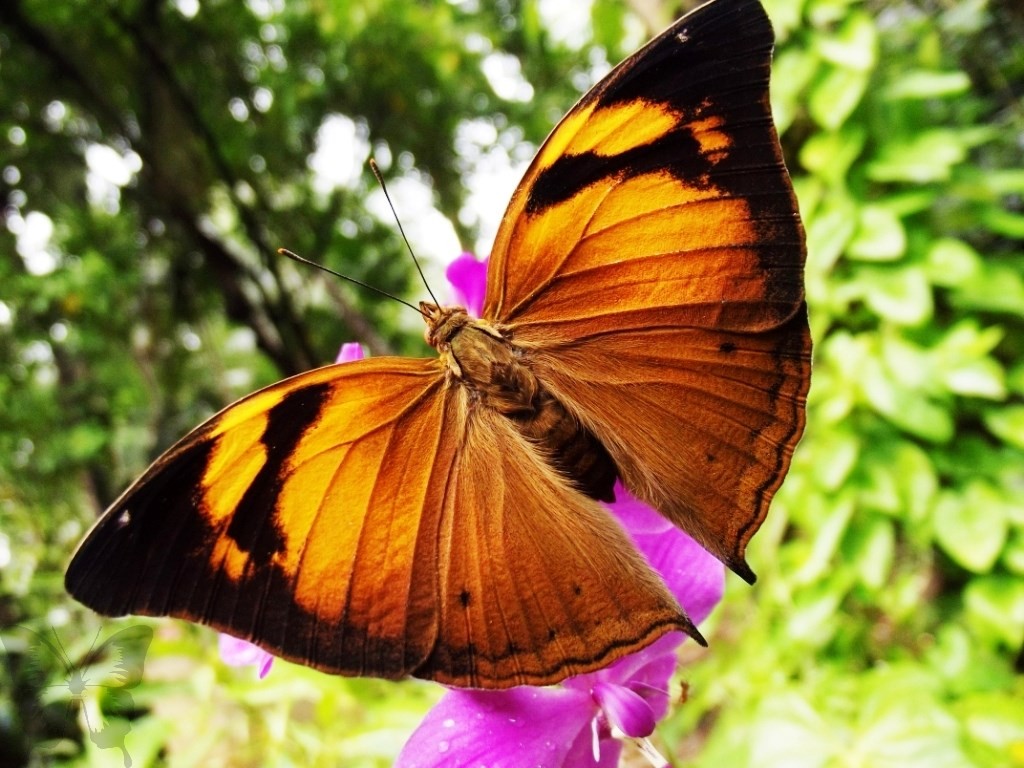
The larvae are black, with two rows of dorsal white spots. Head with a pair of branched spines; rest of the segments with a dorsal and a lateral row of blue branched spines on each side. The pupae are yellowish with numerous black spots; constricted in the middle; head produced into two points. Male's and female's underside yellowish brown, paling anteriorly to rich golden yellow on the forewing, shading anteriorly into dusky brown on the hindwing. Forewing: the apical half black, following a line from vein 12 opposite the discocellulars, passing through apex of cell, obliquely across middle of interspace 3 and curving down to tornus; a black spot near apex of cell coalescing with the inner margin of 1he black colour; a short, very oblique, broad golden-yellow band, broader in the female than in the male, from middle of costal margin to interspace 5; a spot beyond in line with it in interspace 4; two, sometimes three, minute, preapical white specks; the cilia fulvous (tawny), touched with white, anteriorly. Hindwing uniform; the costal margin broadly as noted above, a subterminal narrow band and narrower terminal line posteriorly, dusky black; a postdiscal black spot in interspaces 2 and 5 respectively; the cilia fulvous. The ground colour varies from reddish to dark greenish brown with irrorations (speckles) of greyish and black scales; apex of the forewing and the terminal margin posteriorly of the hindwing more or less lilacine; forewings and hindwings crossed by a dark narrow discal fascia, generally bordered on the inner side by a greyish line; this fascia bent inwards at right angles above vein 6 of the forewing and in most specimens, bordered internally by a diffuse pale patch and externally by an oblique whitish mark, beyond which is a subcostal white spot, followed by a transverse sinuous postdiscal series of obscure ocelli crossing both wings, each ocellus centred by a minute dot, white on the fore, black on the hindwing. In the male there are generally, but not invariably, a number of whitish spots on the basal areas of both wings. Antennae blackish brown, ochraceous at apex; head, thorax and abdomen dark fulvous brown; beneath, the palpi white, the thorax and abdomen pale brown. Wingspan is about 8 - 9 cm.
8. Yellow-barred flutterer
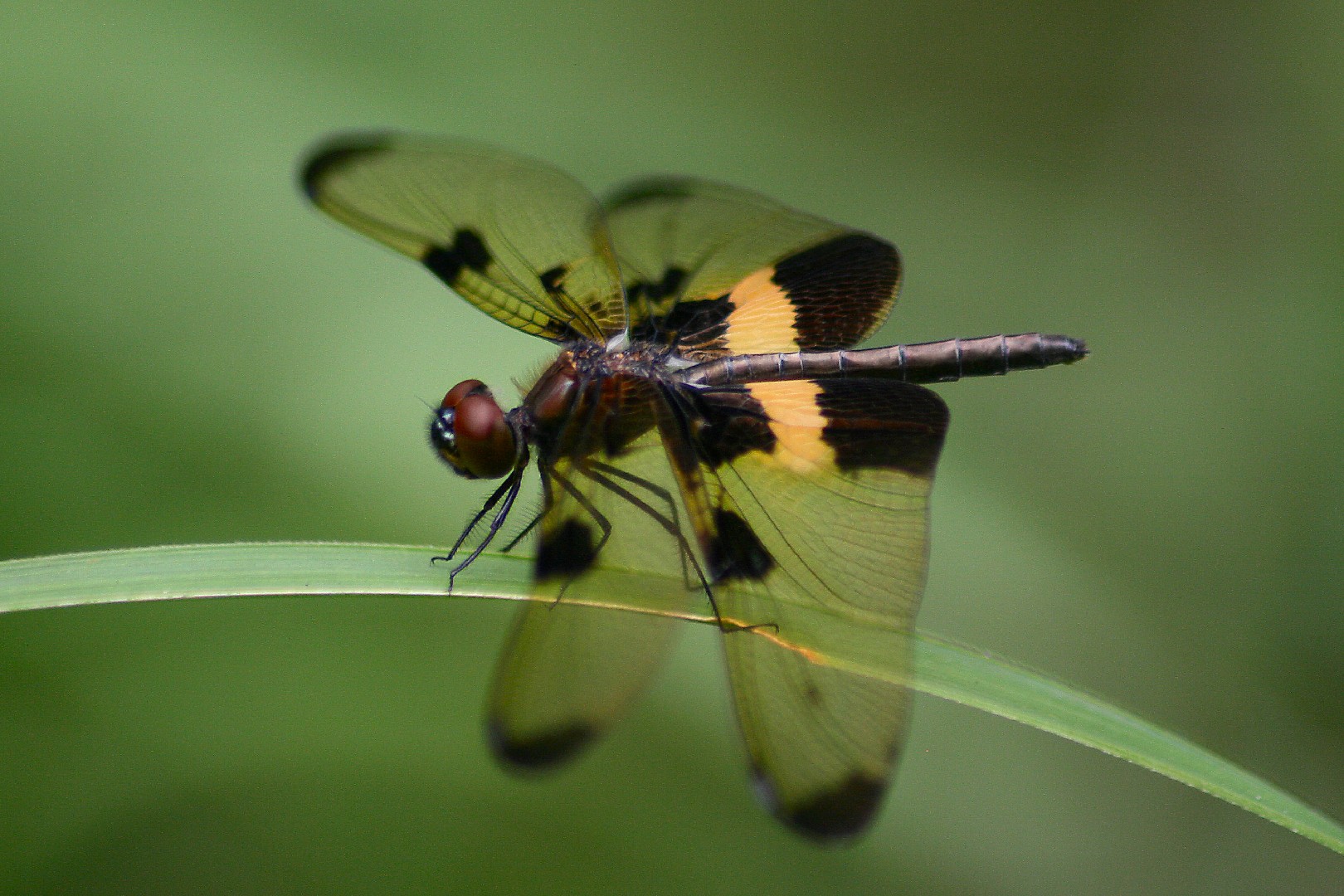
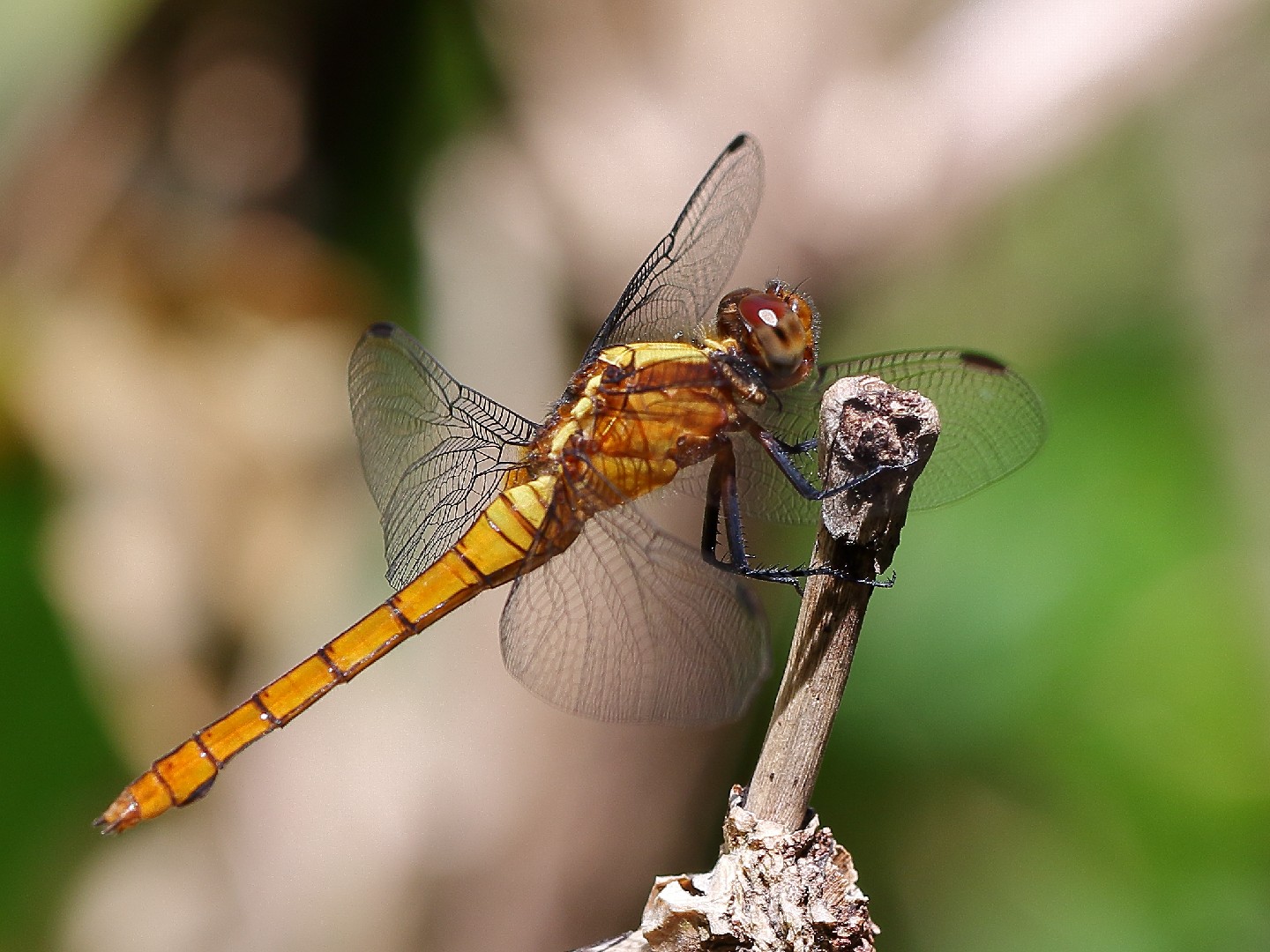
The scientific name Rhyothemis phyllis was first validly published in 1776 by Sulzer.
9. Triangles
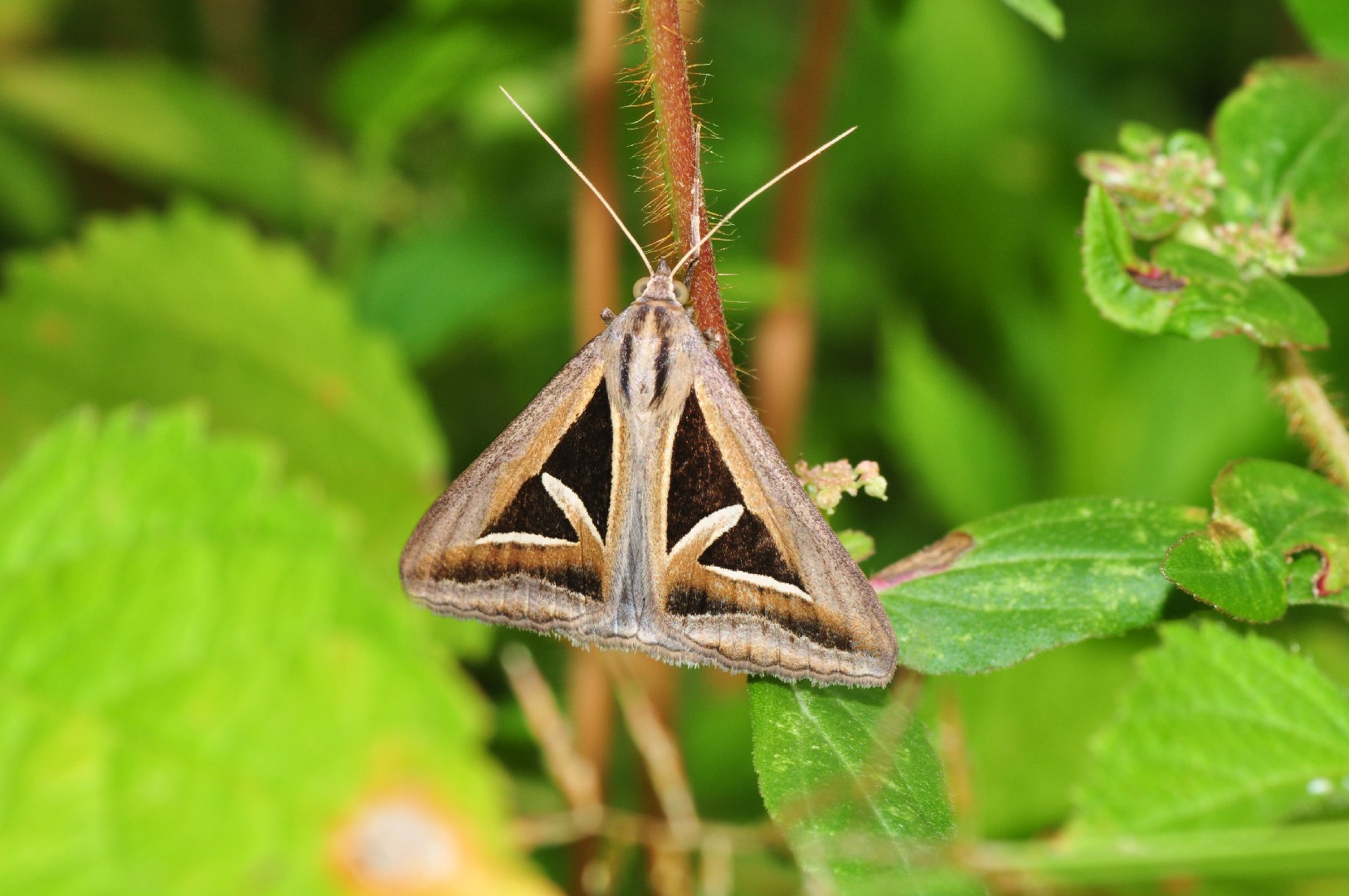
The wingspan is about 3 - 4.5 cm. Antennae of male ciliated. Mid and hind tibia hairy. Body pale ochreous brown, slightly suffused with fuscous or dark grey brown. Forewings with a large black white-edged triangular patch easily distinguished below the cell from near base to towards outer angle. A similar smaller patch found beyond the cell on vein 5, with some pale fulvous behind it. A slightly sinuous submarginal pale line with patches of black suffusion found inside it and a series of black specks beyond it. A dark marginal line can be seen as well. Hindwings with indistinct medial line and fuscous suffused outer area. Larva has yellow upper half and brown ventral part. The yellow part is broken by longitudinal brown bands, which faints towards posterior and becomes intensive again in prolegs. Eggs olive green and speckled rusty red. First few instars are green with three lateral purple brown lines. Late instars are yellowish. Pupa within a slight cocoon of white silk, which spun amongst leaves.
10. Impatiens hawk moth
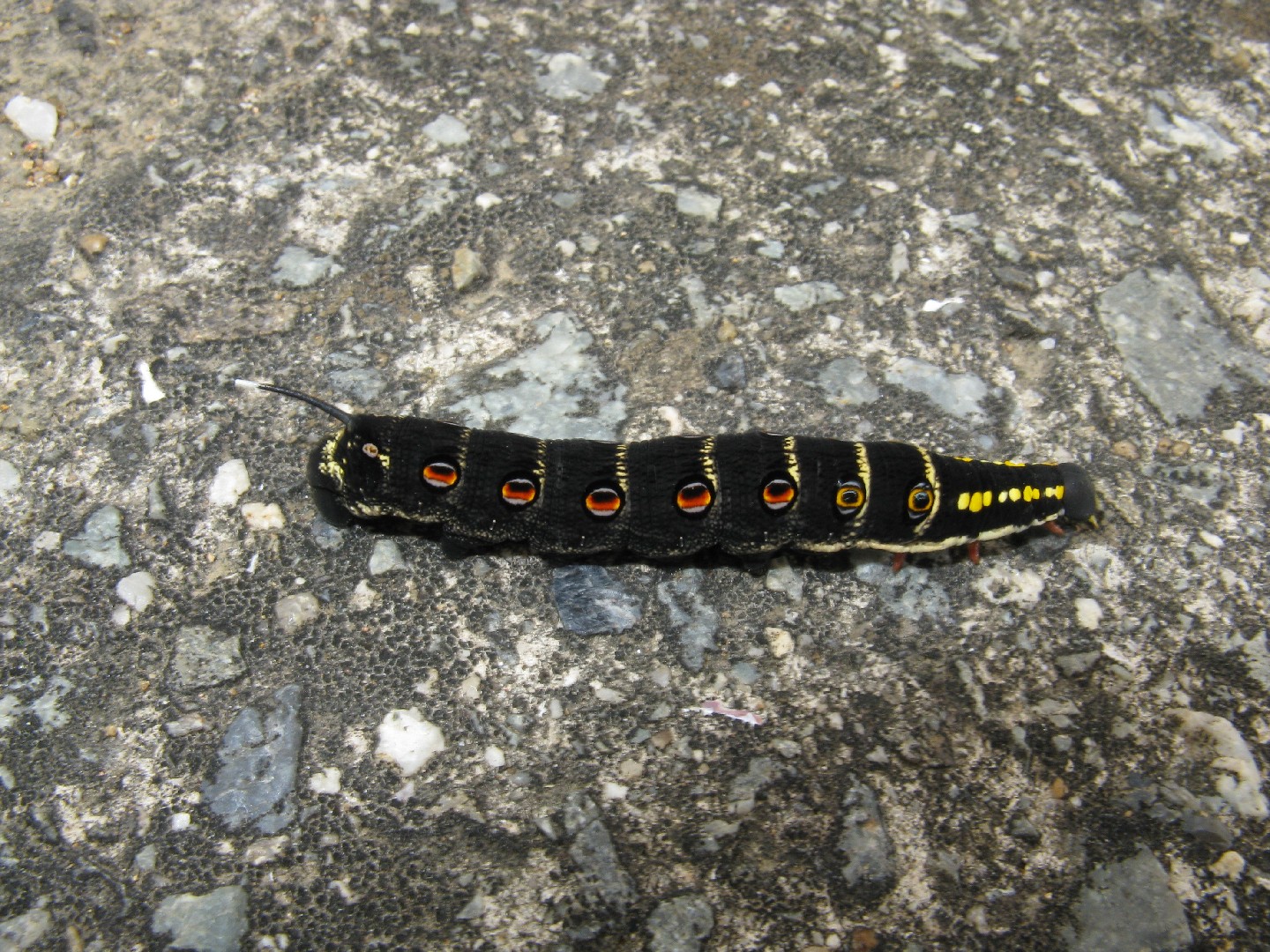
The impatiens hawk moth can be considered a pest among commercial and residential gardeners. Both the moth and caterpillar feed on several flowering plants, including fuchsias and the Australian native violet. Adult females lay their eggs on the plant’s foliage, ensuring the hatching larvae have a ready food source.

More







