




Top 20 Most Common Insects in Medan
Insects, distinct for their six legs and segmented body, inhabit every corner of Medan, dotted with diverse landscapes ranging from lush rainforests to volcanic highlands. These environments act as vibrant arenas for insect diversity, supporting both pests and allies in the ecosystem. Our enumeration of 20 most common insects in Medan illustrates the interplay of local habitats and insect inhabitants, underlining the crucial role insects play in our environment.

Most Common Insects
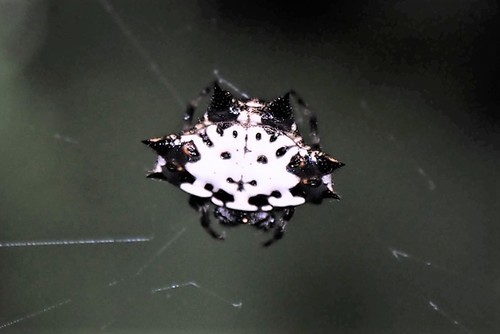
1. Black-and-white spiny spider
Female black-and-white spiny spider are 6 - 9 mm wide and possess a hard, shiny abdomen armed with six black conical spines. The upper surface of the abdomen is white to yellowish with variable black or dark brown markings and sigilla. Males are much smaller at 3 - 4 mm and in place of spines have small bumps on their abdomens. 
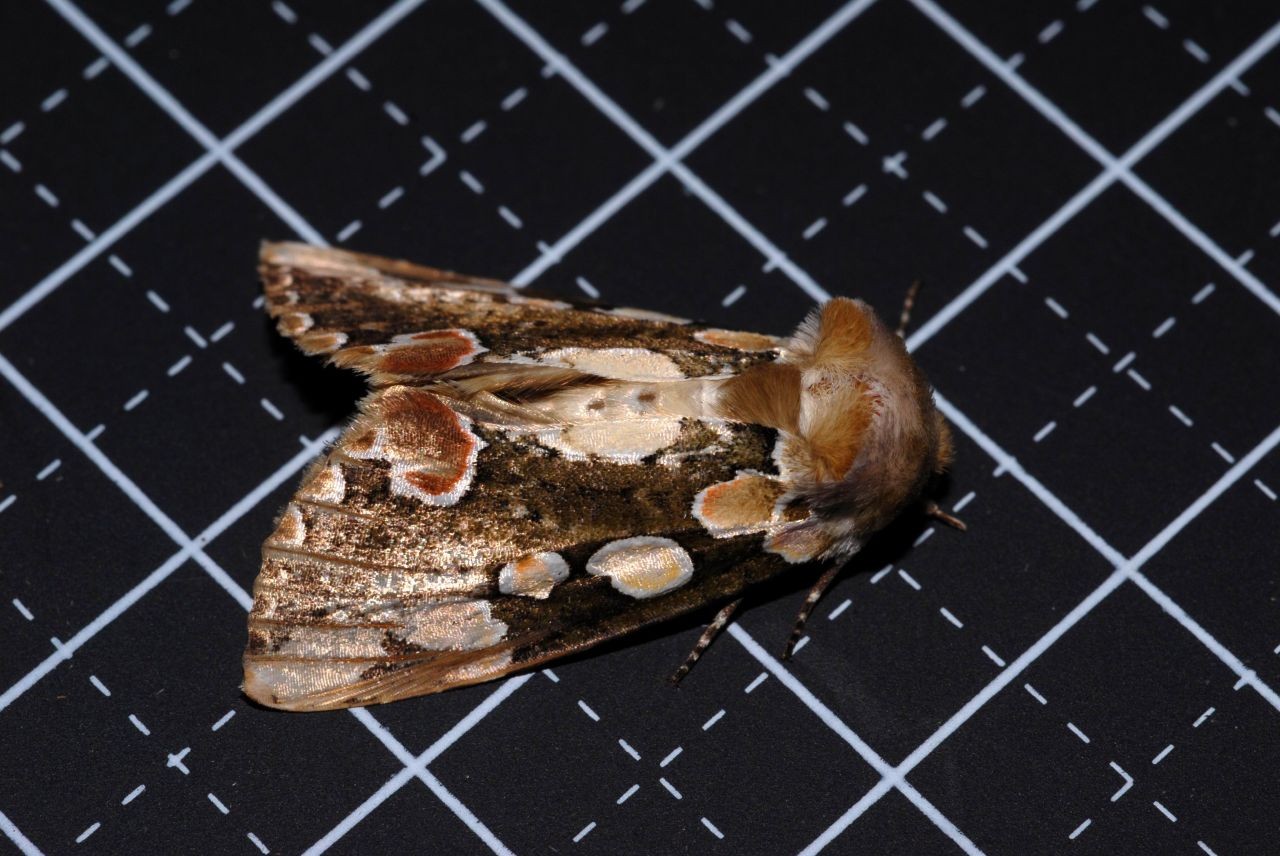
2. Horithyatira decorata
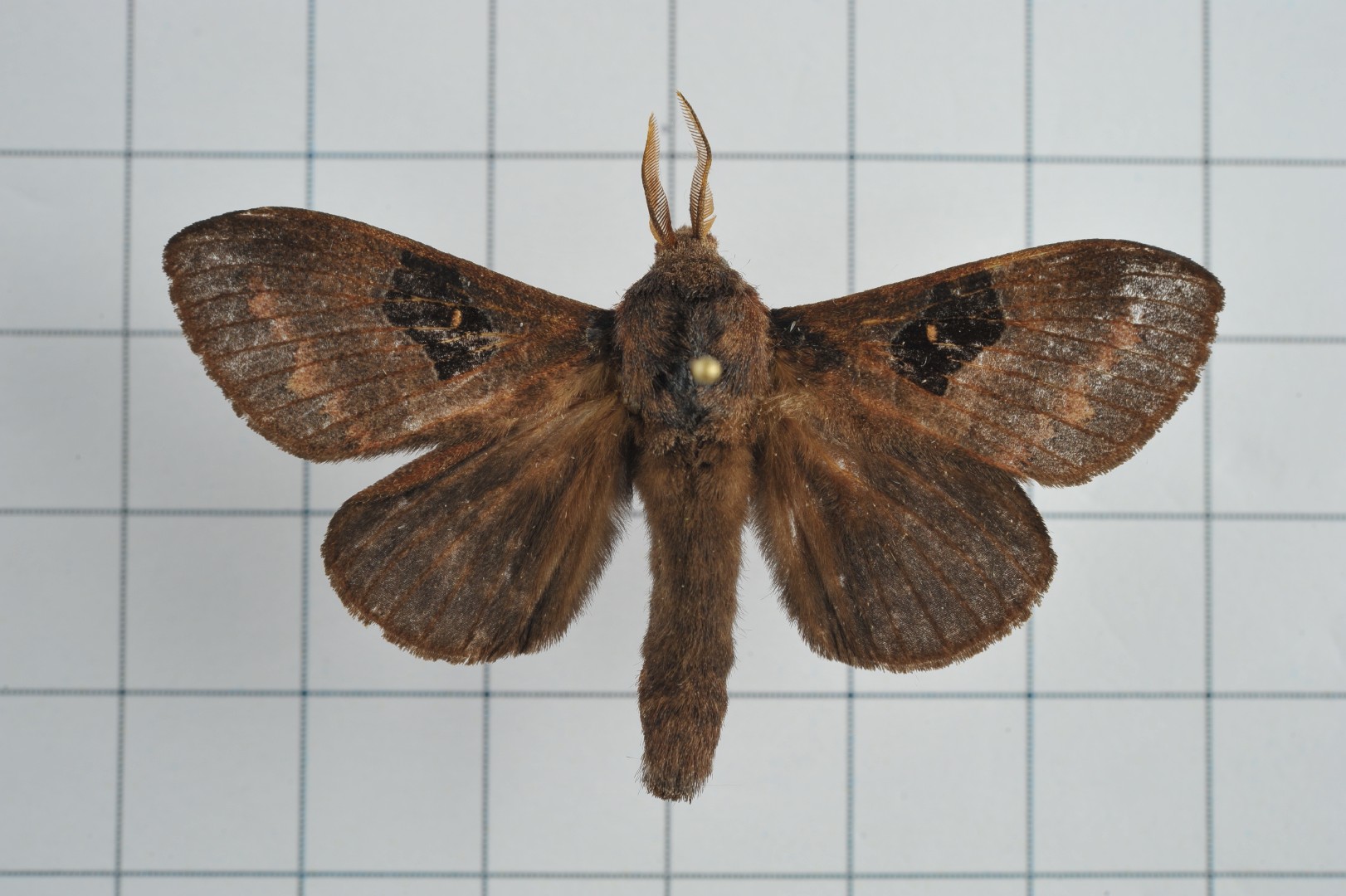
Horithyatira decorata is a butterfly from the single-tailed family (Drepanidae). The scientific name of the species was first validly published in 1881 by Moore.
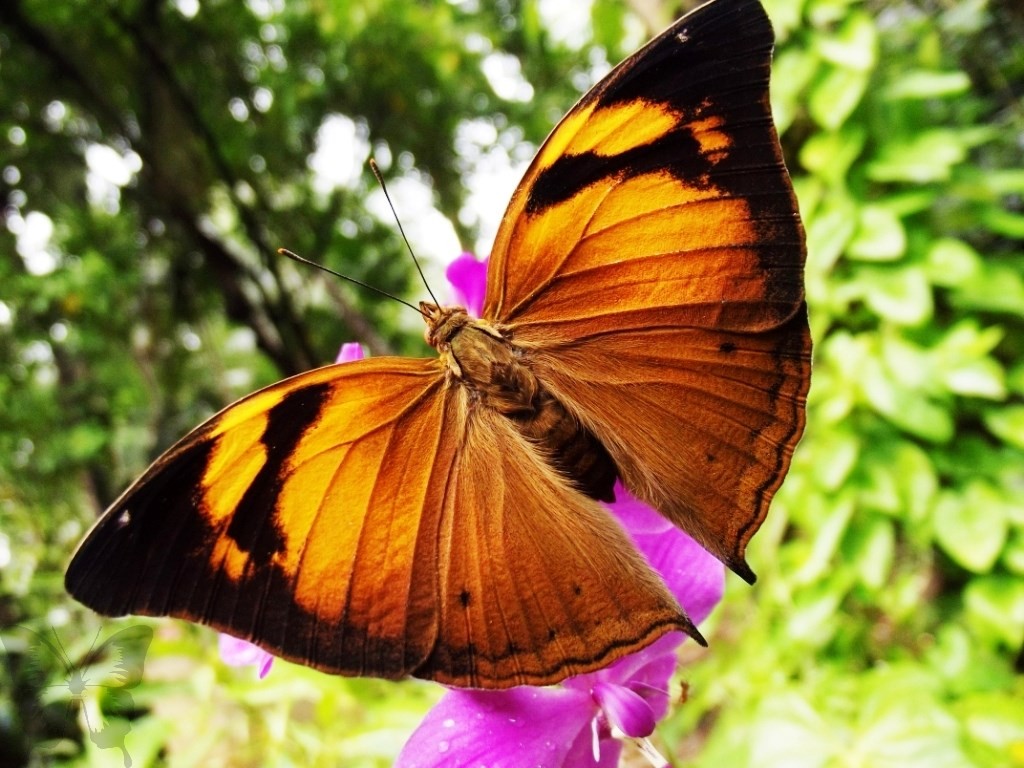
3. Autumn leaf
The larvae are black, with two rows of dorsal white spots. Head with a pair of branched spines; rest of the segments with a dorsal and a lateral row of blue branched spines on each side. The pupae are yellowish with numerous black spots; constricted in the middle; head produced into two points. Male's and female's underside yellowish brown, paling anteriorly to rich golden yellow on the forewing, shading anteriorly into dusky brown on the hindwing. Forewing: the apical half black, following a line from vein 12 opposite the discocellulars, passing through apex of cell, obliquely across middle of interspace 3 and curving down to tornus; a black spot near apex of cell coalescing with the inner margin of 1he black colour; a short, very oblique, broad golden-yellow band, broader in the female than in the male, from middle of costal margin to interspace 5; a spot beyond in line with it in interspace 4; two, sometimes three, minute, preapical white specks; the cilia fulvous (tawny), touched with white, anteriorly. Hindwing uniform; the costal margin broadly as noted above, a subterminal narrow band and narrower terminal line posteriorly, dusky black; a postdiscal black spot in interspaces 2 and 5 respectively; the cilia fulvous. The ground colour varies from reddish to dark greenish brown with irrorations (speckles) of greyish and black scales; apex of the forewing and the terminal margin posteriorly of the hindwing more or less lilacine; forewings and hindwings crossed by a dark narrow discal fascia, generally bordered on the inner side by a greyish line; this fascia bent inwards at right angles above vein 6 of the forewing and in most specimens, bordered internally by a diffuse pale patch and externally by an oblique whitish mark, beyond which is a subcostal white spot, followed by a transverse sinuous postdiscal series of obscure ocelli crossing both wings, each ocellus centred by a minute dot, white on the fore, black on the hindwing. In the male there are generally, but not invariably, a number of whitish spots on the basal areas of both wings. Antennae blackish brown, ochraceous at apex; head, thorax and abdomen dark fulvous brown; beneath, the palpi white, the thorax and abdomen pale brown. Wingspan is about 8 - 9 cm.
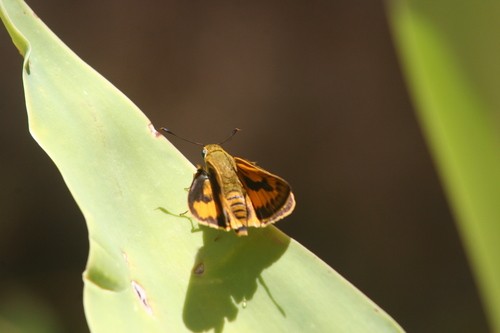
4. Yellow palm dart
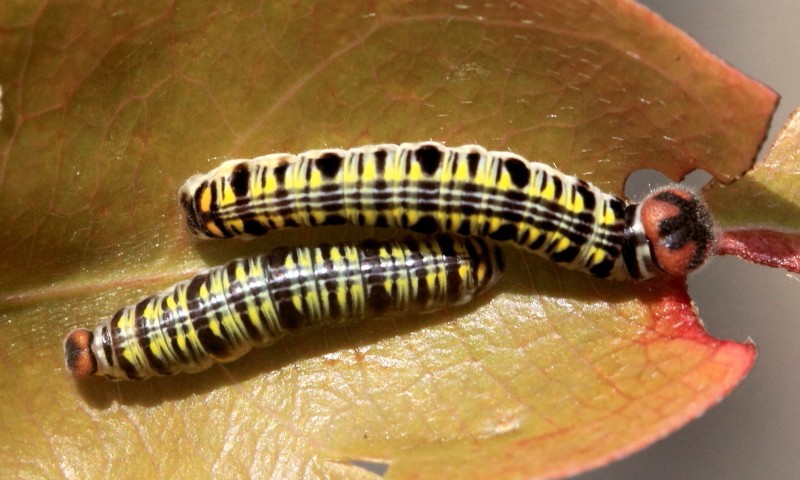
The wingspan is about 4 cm.
5. Orangetail awlet
Both sexes: The butterfly has a wingspan of 45 to 50 mm. Above, both sexes are an unblemished dark brown. The hindwings have an orange fringe. The abdomen is orange towards the rear. Below, the wings have white patches; the forewings having a large white central patch, and the hindwings having a broad pure white discal band. The male has no brands.
6. Thyas honesta
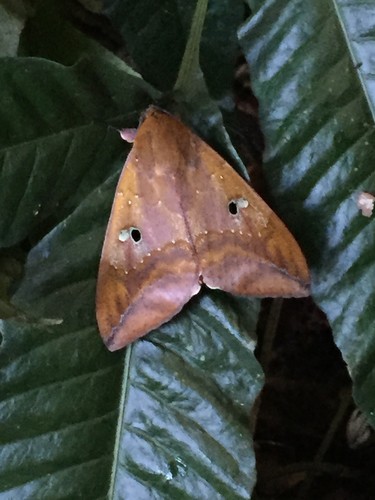
Its wingspan is about 84–104 mm. Head and thorax reddish chestnut in colour, where the third joint of palpi black. Abdomen crimson. Forewings reddish chestnut, slightly irrorated with dark scales. There are traces of a sinuous antemedial line with three specks on it. Reniform greyish, where the lower part more or less completely filled in with black. A curved postmedial series of white specks with an indistinct band beyond it angled at vein 6 and met by a dark streak from the apex. A marginal series of specks present. Hindwings crimson with black sub-marginal medial patch. Larva ophiusine-shaped with an apple-greenish body and finely lined longitudinally with purple-centered double white lines. The dorsolateral pair of conical tubercles are yellowish patched with red. The larvae feed on Careya, Barringtonia and Planchonia species.
7. Coconut skipper
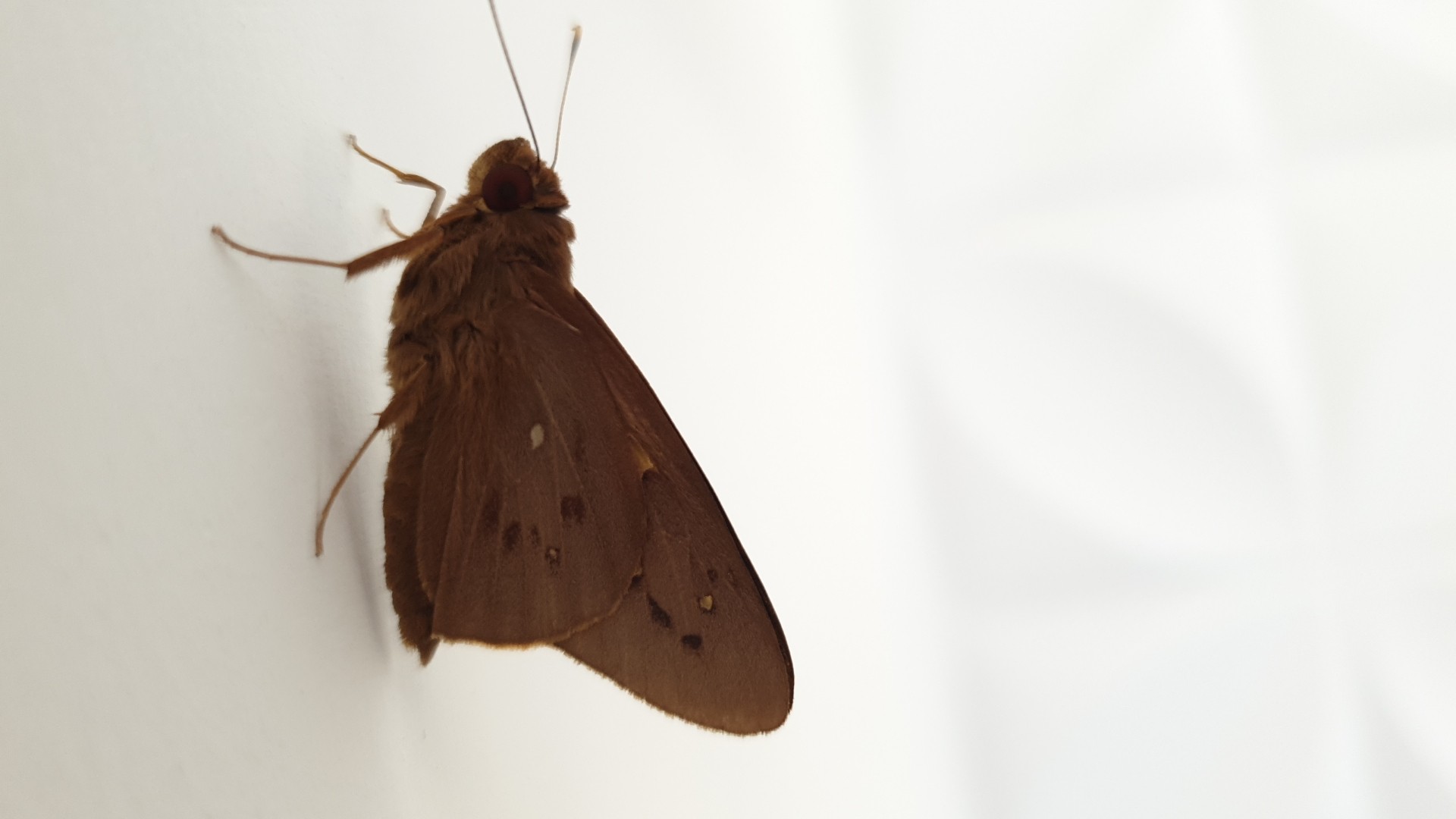
Hidari irava, the coconut skipper, is a butterfly of the family Hesperiidae. It is found in southern Myanmar, Thailand, western Malaysia, as well as on Sumatra, Java, Borneo and the Sula Islands. The wingspan is 45–55 mm. The larvae feed on Bambusa species and Cocos nucifera.
8. Xyleutes strix
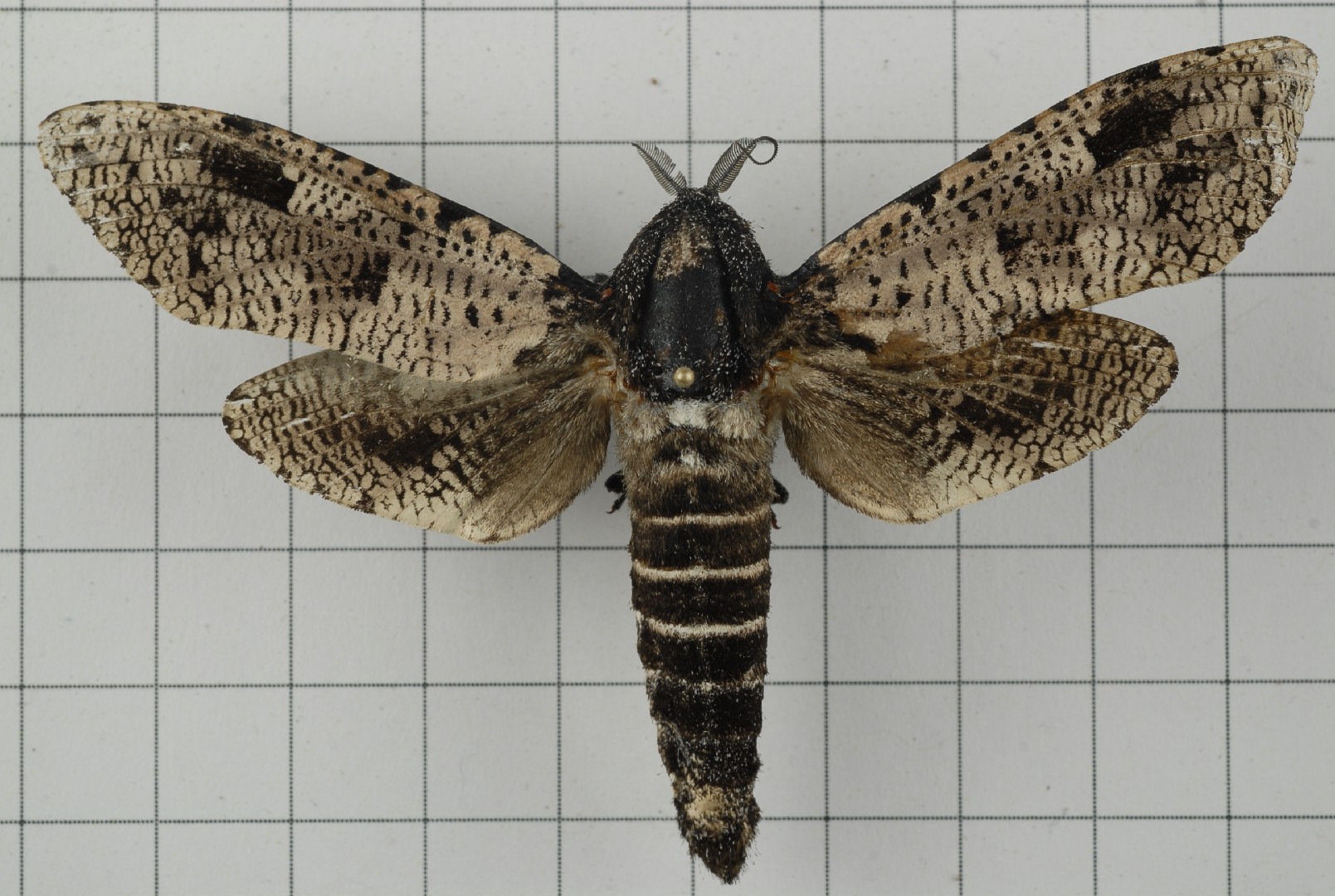
Xyleutes strix is a moth of the family Cossidae. It is found in India, south-eastern Asia, Sundaland, the Philippines, Sulawesi, the Moluccas and New Guinea.
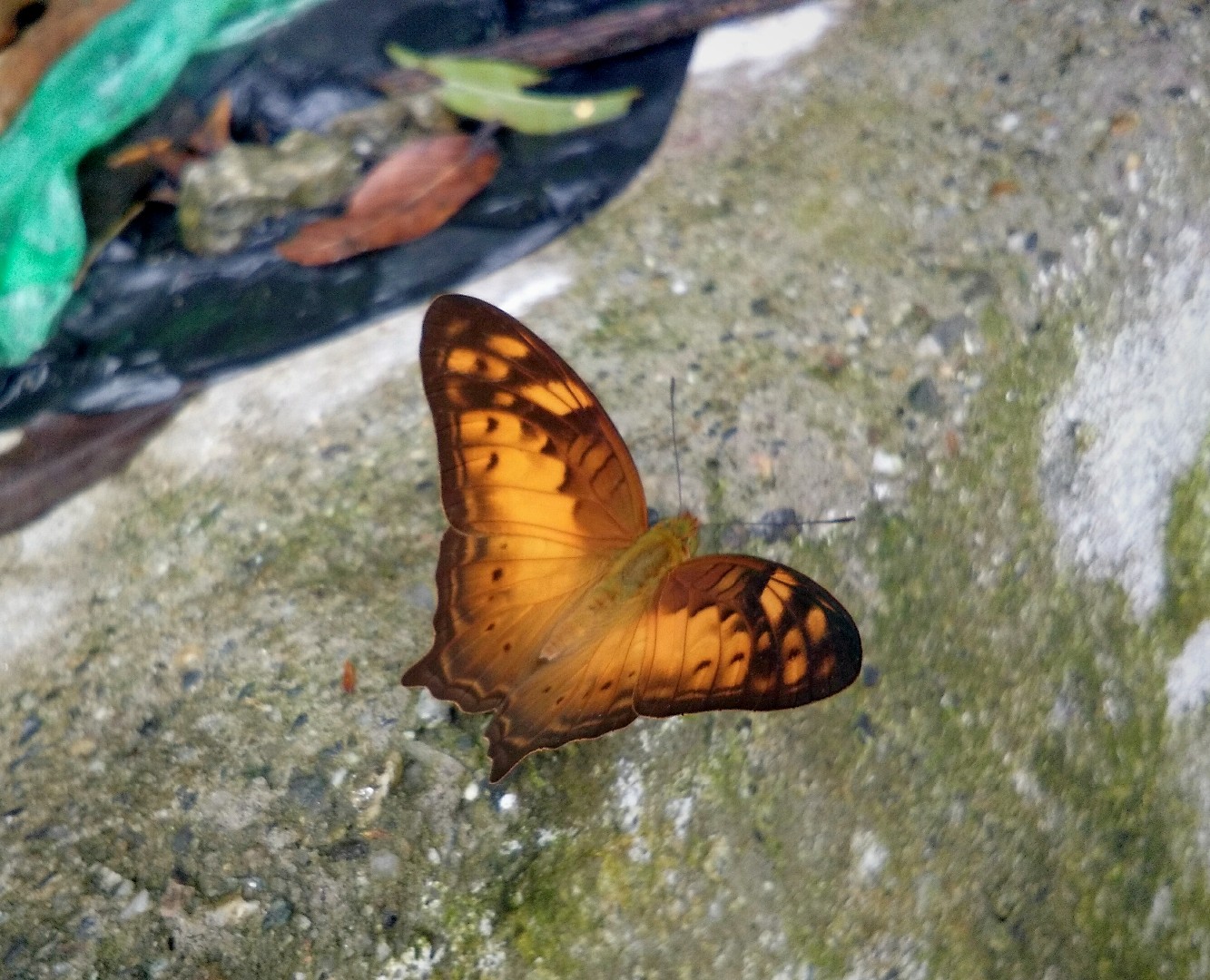
9. Tailed rustic
Vagrans is monotypic genus with the species vagrant (Vagrans egista) a species of nymphalid butterfly found in forested areas of tropical South Asia and Southeast Asia.
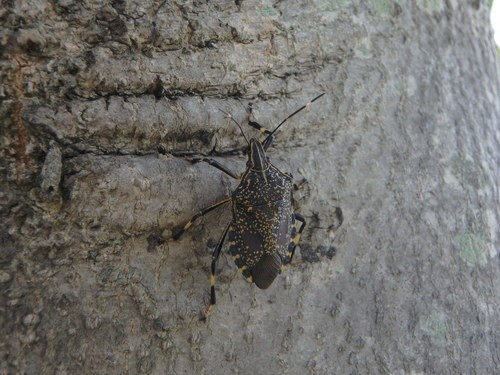
10. Yellow-spotted stink bug
The yellow-spotted stink bug has a wide distribution across Asia. In China, the insect is a pest to more than 57 plants, including fruit trees. It can damage plants and reduce crop yields. Adults overwinter in natural and manmade shelters like building crevices and underneath tree bark, emerging in the spring to feed on the tree’s new growth.
More







