




Top 20 Most Common Insects in Lithuania
Insects are biologically diverse, residing in nearly every corner of works like Lithuania, thanks to different ecosystems and human activities. The most common insects, or our 'Top 20', manifest across our varied landscapes and climates, each presenting unique roles - ranging from pesky nuisances to essential pollinators. Understanding these diminutive inhabitants provides valuable insights into Lithuania's ecological integrities.

Most Common Insects
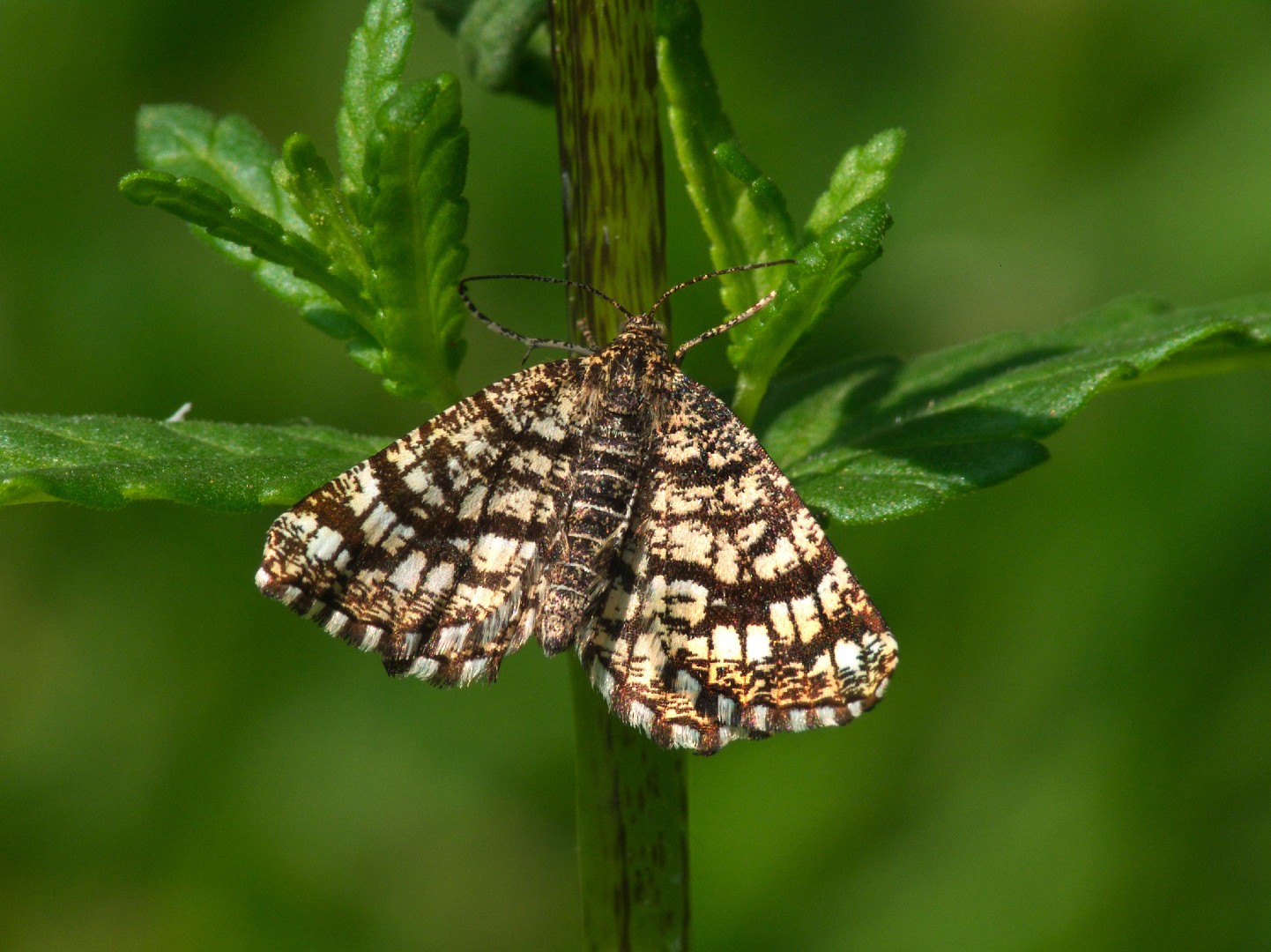
1. Latticed heath
The latticed heath (Chiasmia clathrata) is a moth of the family Geometridae, belonging to the subfamily Ennominae, placed in the tribe Macariini. The genus was erected by Carl Linnaeus in his 1758 10th edition of Systema Naturae. 
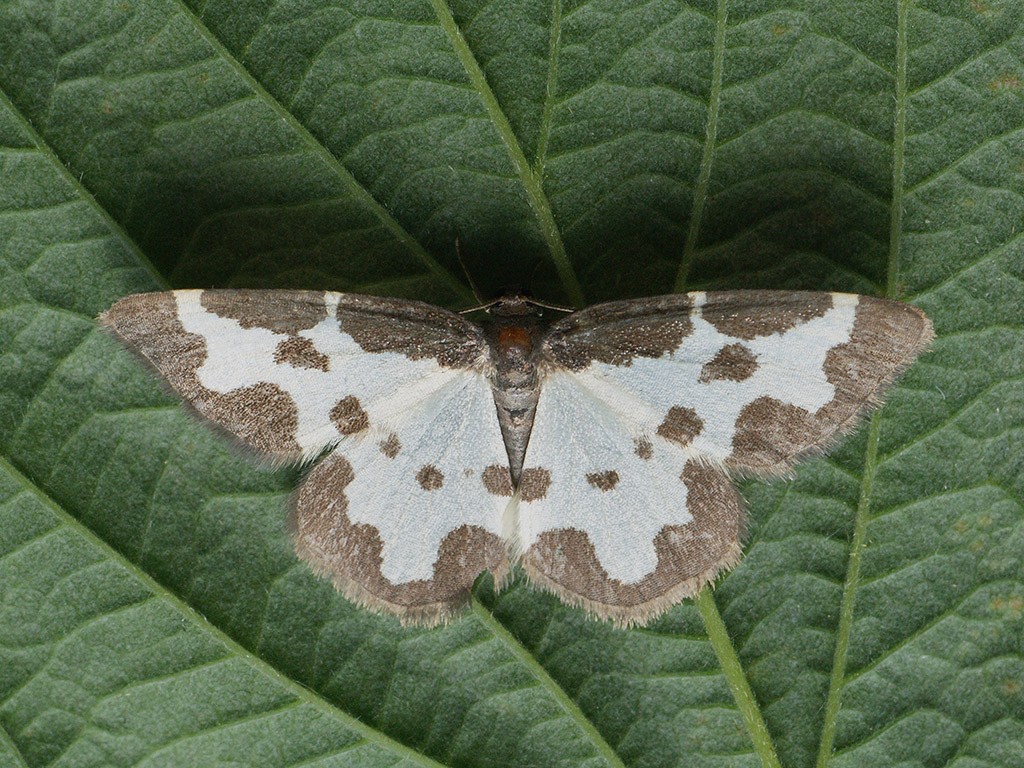
2. Clouded border
This is a very distinctive species with white wings marked with black blotches around the margins. The amount of black varies, with the males usually (though not always) having more extensive black areas than the females. Occasionally almost entirely white or black individuals are seen, although this is rare. The wingspan is 2.5 - 3 cm. Lomaspilis marginata is extremely variable. Linnaeus's form has complete black border to both wings, also on the forewing additional spots or patches at base and middle of costa. The egg is yellow green, with hexagonal reticulation. The larva, pale green with darker dorsal lines and a purplish anal spot.
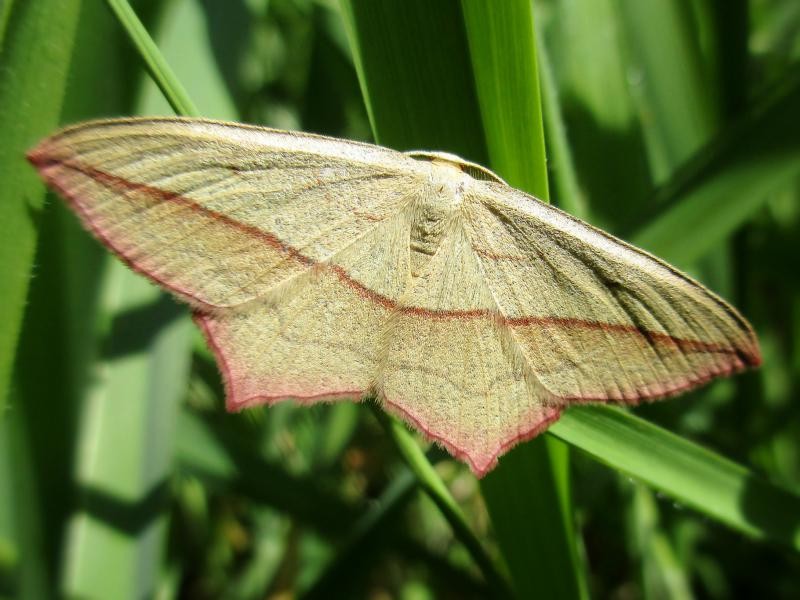
3. Blood-vein
The wings are cream coloured with bold red or purple fascia forming a diagonal stripe across forewings and hindwings. All wings are fringed with the same colour. The tornus of the hindwing is sharply angled giving a distinctive shape. The wingspan is 3 - 3.5 cm.
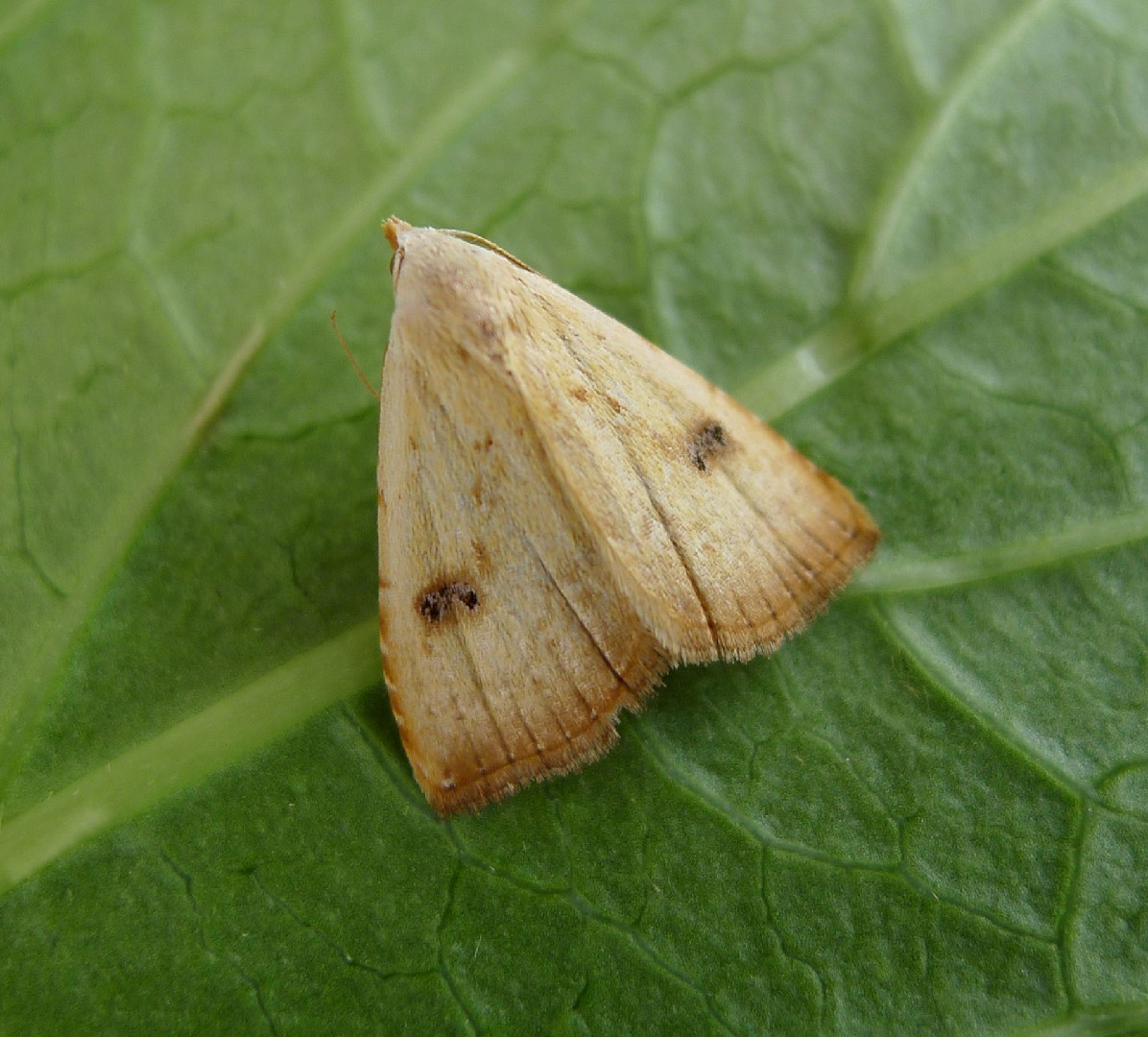
4. Straw dot
The silk sorrel (Rivula sericealis) is a butterfly (moth) from the family Eulenfalter (Noctuidae).
5. Pebble hook-tip
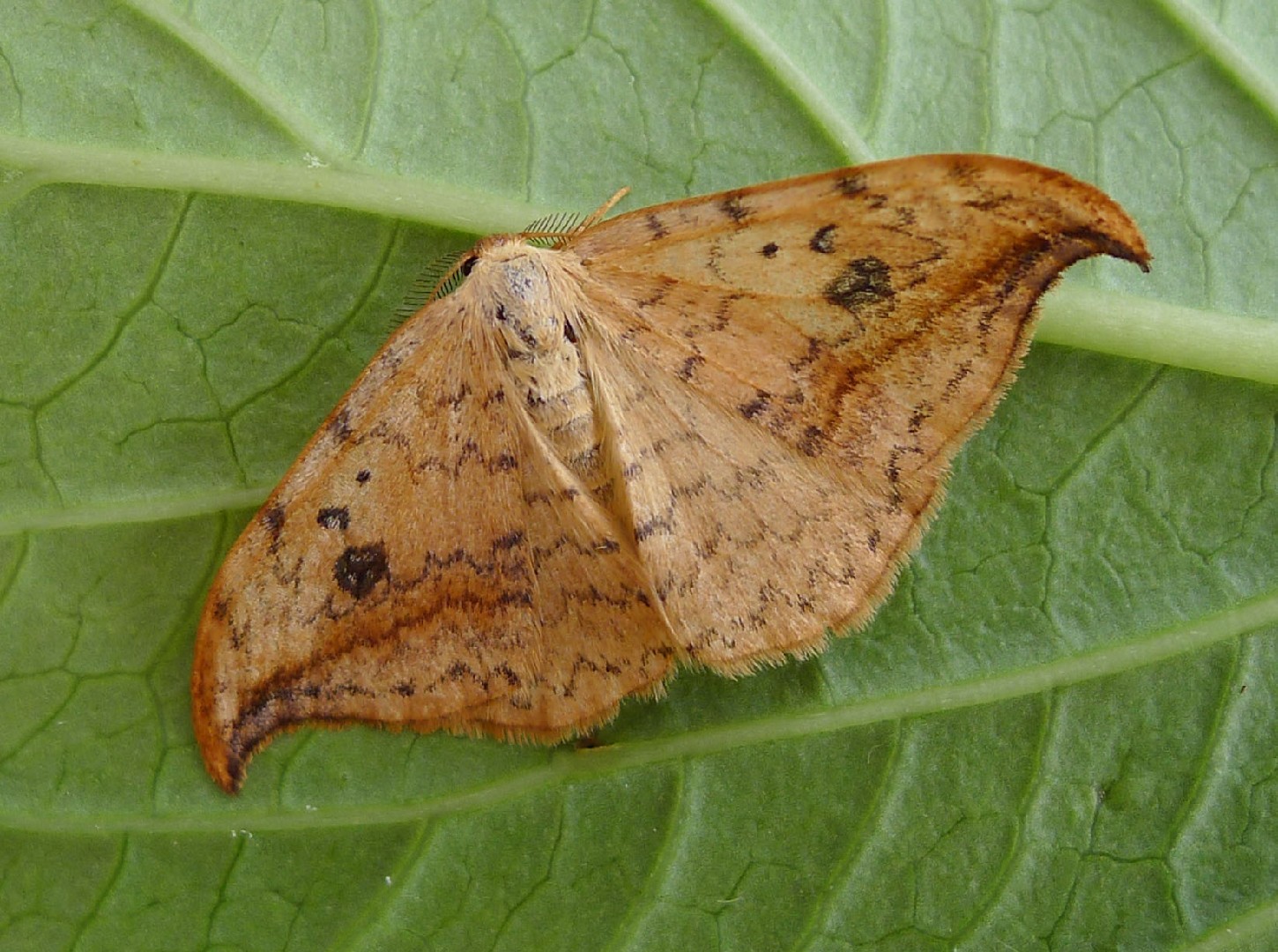
The wingspan is 2.5 - 3.5 cm. The ground colour is light brown or white brown to reddish brown. The forewings, which exhibit a fine regular pattern of dark, finely serrated lines have a dark patch in the middle. Under the sickle, or on the outer part of the outer edge of the wing, there is a purple stain. From the wing tip, a clearly curved, dark brown band runs under the stain up to the edge of the wing. The hindwings are also light brown, but brighter than the forewings. Their pattern is similar to but not so strong as that of the forewings. In the females the hindwings are white with the same dark patterning. The egg is yellow marked with orange at one end. The last instar caterpillar is green, the dorsum reddish brown, except towards the black-marked yellowish head. There are two conspicuous warts on rings two and five, and less obvious raised spots on the other rings, all bearing hairs. In the younger stages it is blackish, with white marks on the fourth and seventh rings; later it becomes greenish below, and the markings on the back of rings four, seven, eight, and ten are whitish or creamy.
6. Common white wave
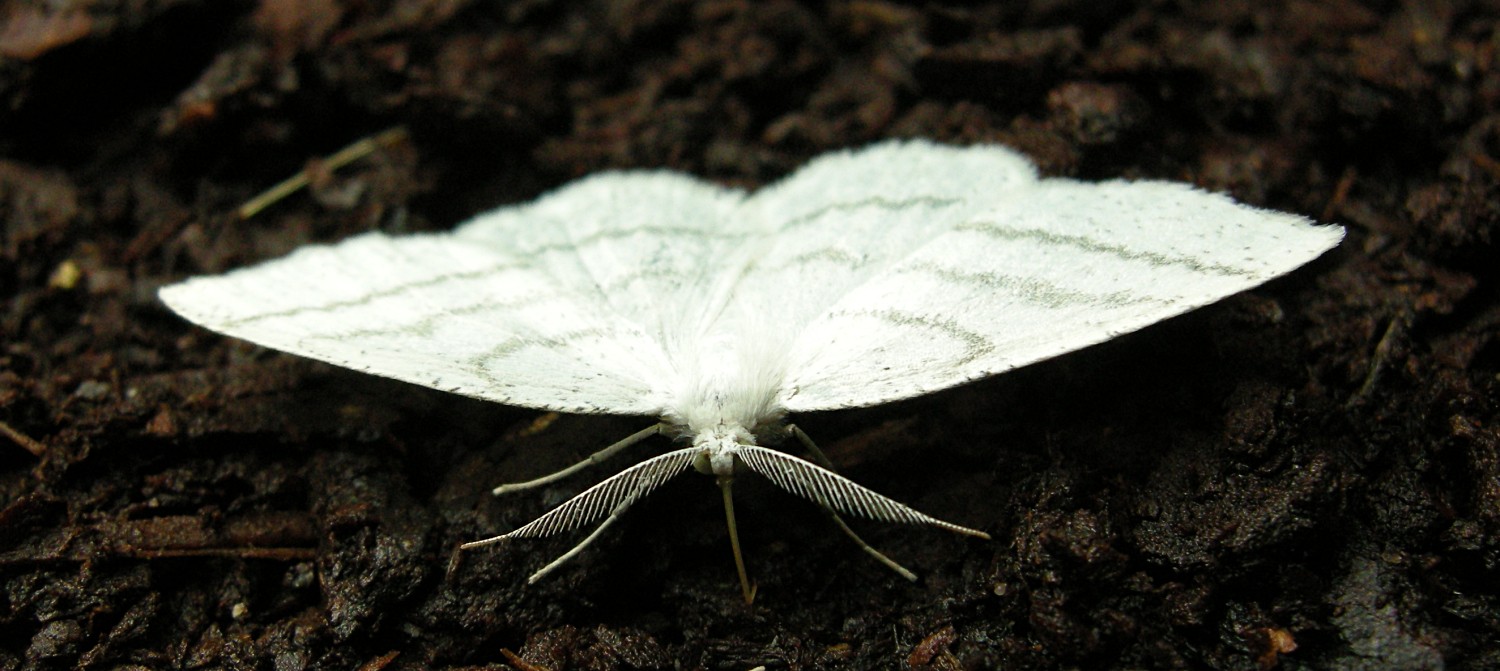
The common white wave (Cabera pusaria) is a moth of the family Geometridae. The species was first described by Carl Linnaeus in his 1758 10th edition of Systema Naturae. It is found throughout the Palearctic region and the Near East.The habitat is deciduous forests and their surroundings. This species has white wings, sometimes tinged with pink, slight grey dusted grey and with fine grey fascia (the first curved) on the forewing and two on the hindwing. ab. heveraria H.-Schiff. is a rare form in which the grey dusting densely covers almost the entire wings. ab. rotundaria Haw. is a rounder-winged form with the first lines strongly approximated and said to be the product of under-feeding the larvae. Hybrid fletcheri Tutt (pusaria male x exanthemata female) is just intermediate between the parent forms, rather pure white, the lines tinged with ochreous. The wingspan is 32–35 mm. One or two broods are produced each year and the adults can be seen at any time from May to August. This moth flies at night and is attracted to light. The larva is elongate, with a rather flattened head is very variable -green with purplish brown or blackish dorsal spots sometimes vague, purplish-brown with white spots, or grey mixed with reddish, or sometimes yellowish. It feeds on various trees and shrubs including alder, aspen, birch, oak, rowan and willow. The species overwinters as a pupa.The pupa is compact, brown, the wings olive-green.
7. Flame shoulder
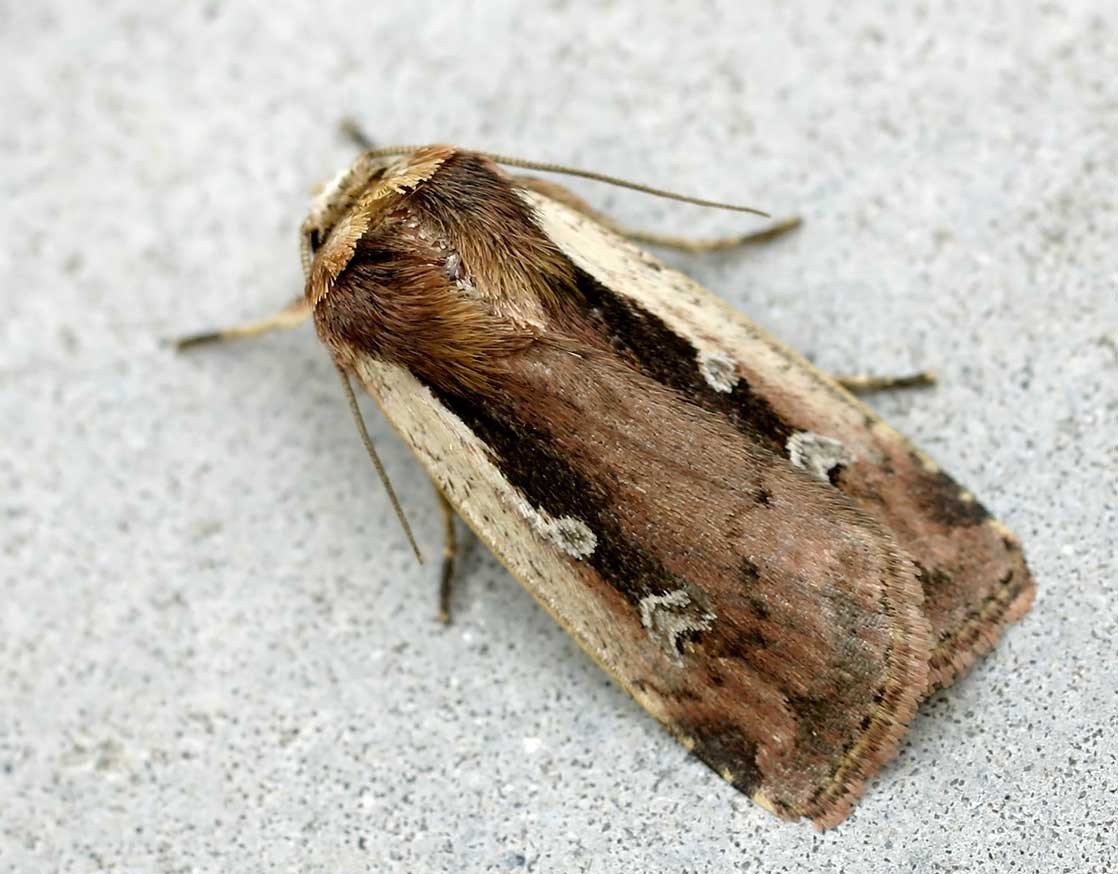
The forewings of this species are reddish brown with a black streak interrupted by white stigmata and a creamy-yellow streak along the costa which gives the species its common name. The hindwings are pure white.
8. Red twin-spot
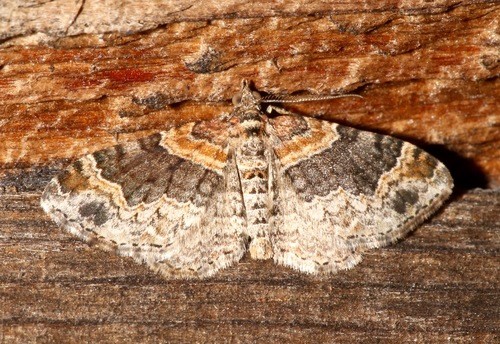
The name-typical form of ferrugata as figured by Clerck and well described by Linne, has the median band reddish or purplish, the distal area very weakly marked (except the costal patch and two dark spots between the radials) often almost entirely white or whitish. An aberration, ab. unidentaria Haw. is a very common and very interesting aberration which has been proved, by my very extensive breeding experiments and those of Dr. Draudt, to be an almost perfect Mendelian "recessive". It differs in having the median band black, not reddish. — ab. coarctata Prout has the median band greatly narrowed, only 1–2 mm. in width; the rest of the markings often in part obsolete. - bilbainensis Fuchs, from Bilbao, said to be a local race, is described as smaller, narrower-winged, the distal edge of the median band more distinctly biangulate. I doubt its validity. — stupida Alph., from Issyk-kul, Tibet, W. Central China, etc., is rather larger, with whiter hindwing otherwise similar to ab. unidentaria. Xanthorhoe ferrugata is difficult to certainly distinguish from Xanthorhoe spadicearia (Denis & Schiffermüller, 1775). See Townsend et al.
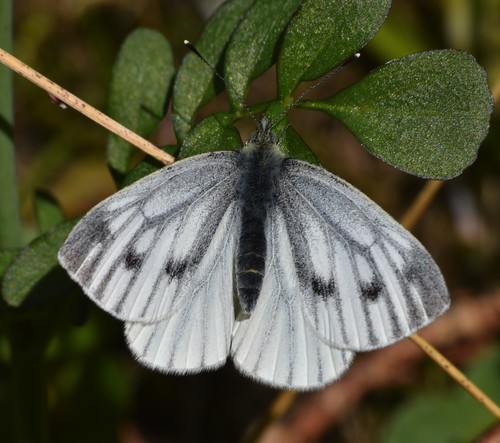
9. Green-veined white
Green-veined white (Pieris napi) is a distinctively white-winged butterfly that lays its eggs in a variety of food plants. This species displays observable differences dependent on sex: males possess only one dark spot on each forewing, whereas females display two. Unlike several of its cousin species, green-veined white prefers not to lay eggs in garden cabbages, rendering it less of a pest to farmers.
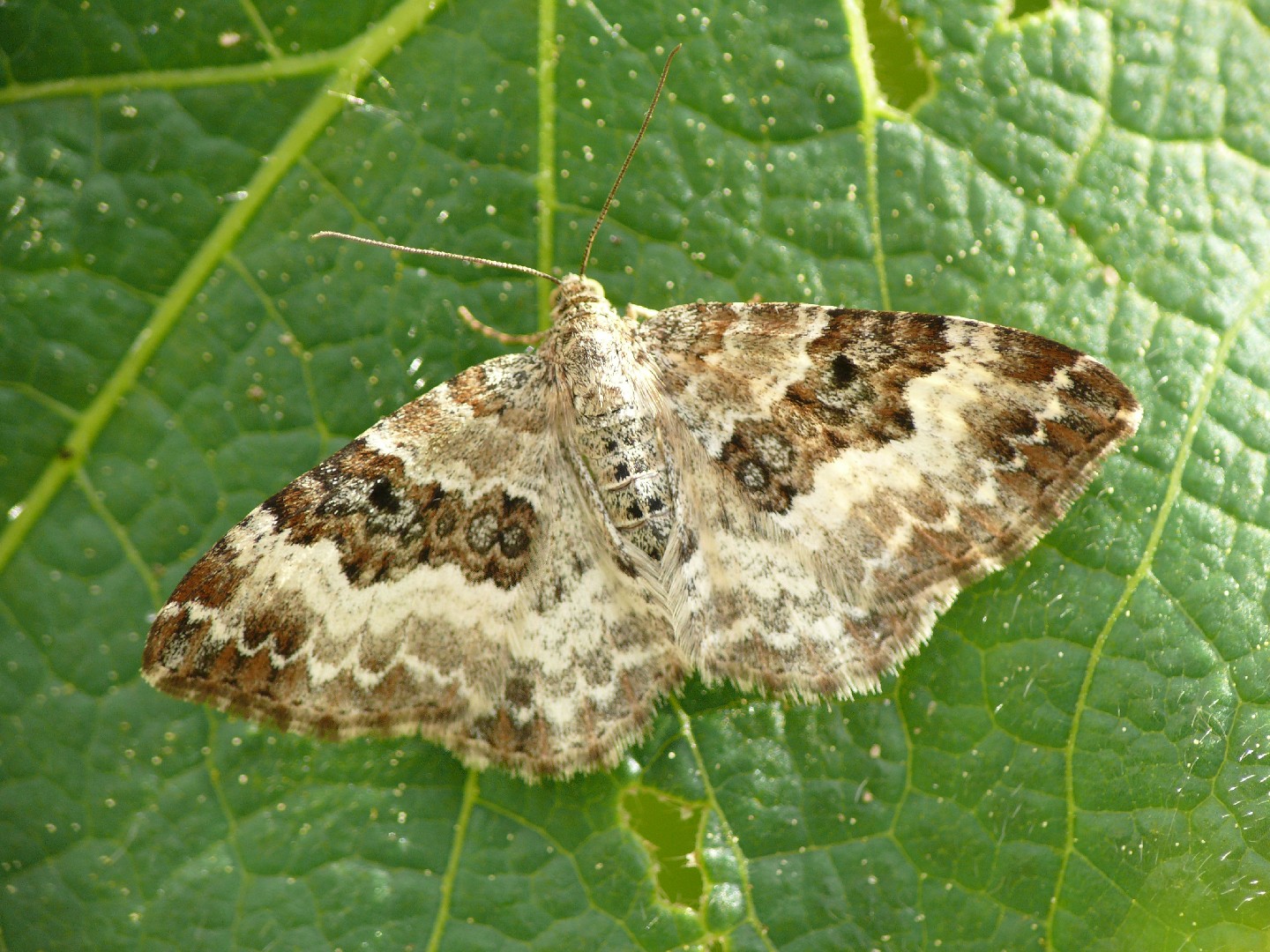
10. White-banded toothed carpet moth
White-banded toothed carpet moth (Epirrhoe alternata) is a species of moth with uniformly gray and brown coloring. Adults are generally seen from late spring to mid-autumn. It is strongly attracted to light and feeds on plants of the genus Galium, known more informally as "bedstraw."
More







