




Top 16 Most Common Insects in Skopje
Venture with us into the unseen world of Skopje's insect populace! These unique creatures, known for their exoskeletons, thrive in a plethora of habitats. Skopje’s diverse geography fosters varied bug species, each playing a vital part in the ecosystem. Whether we view them as pests or helpers, their presence is an indicator of Skopje's environmental health. Stay tuned as we explore the top 16 most common insects in this fascinating region!

Most Common Insects
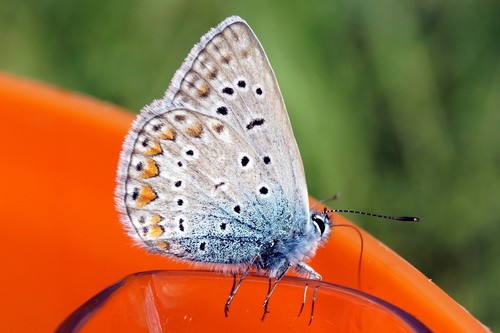
1. Common blue butterfly
Despite its common name, only male specimens of common blue butterfly (Polyommatus icarus) can accurately be described as blue; the females are predominately gray-brown, with only a dusting of blue and a scattering of orange spots. The adults live for only three weeks before dying.
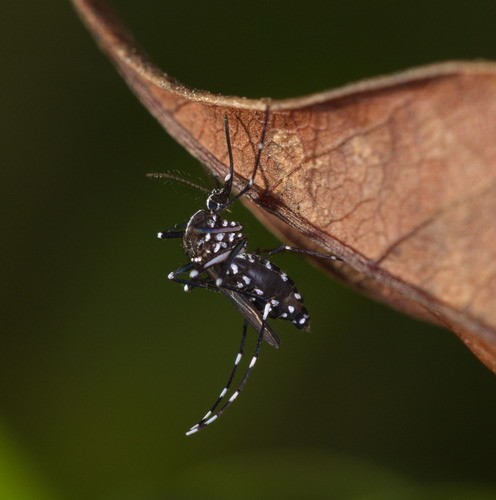
2. Asian Tiger Mosquito
The asian Tiger Mosquito (Aedes albopictus) has recently (the 1970s) infested every corner of the world through the shipment of used tired, lucky bamboo (Dracaena sanderiana), and other similar products. The asian Tiger Mosquito is known to transmit many deadly diseases that include West Nile Virus.
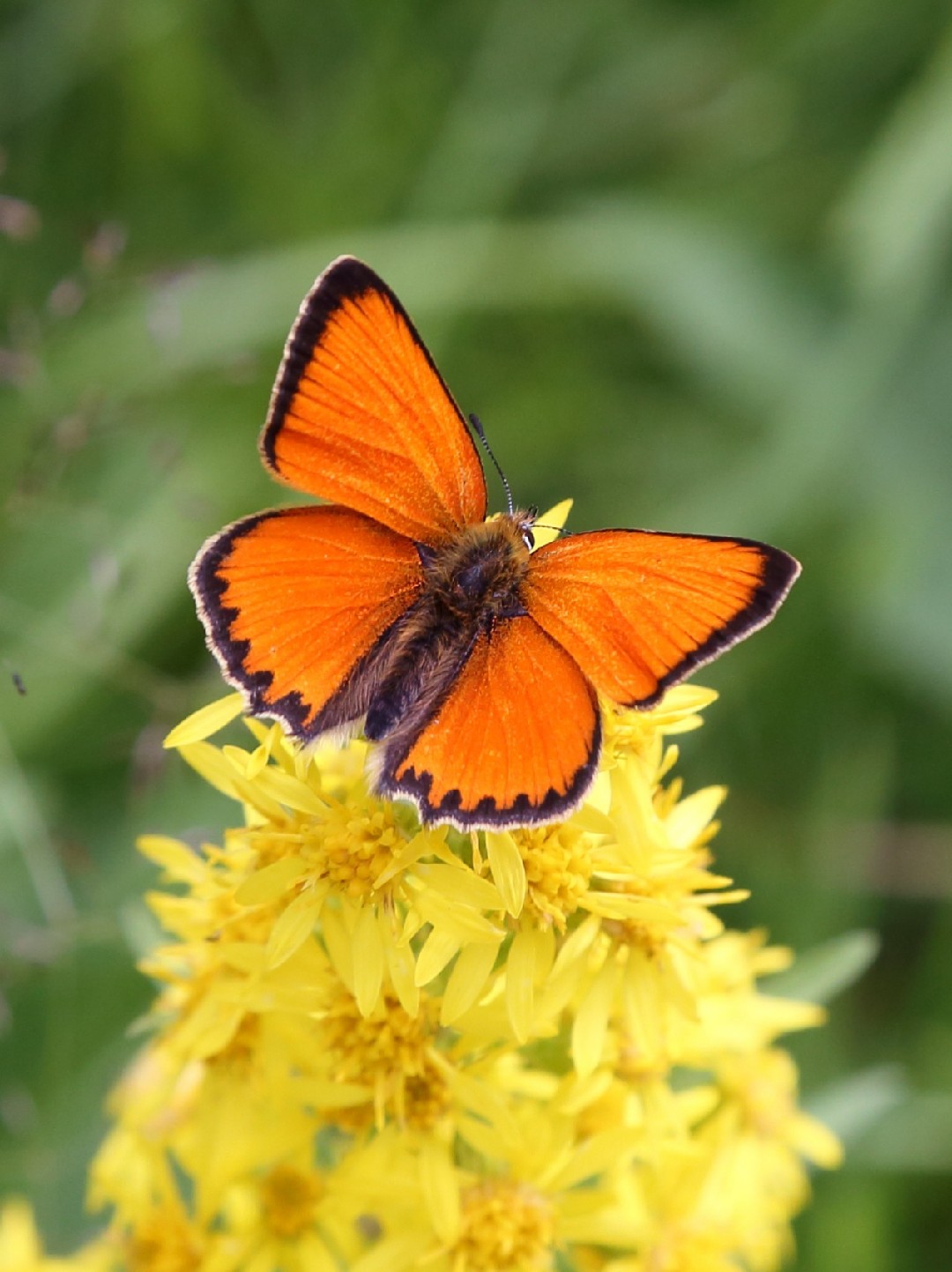
3. Scarce copper
Male above red-golden, with a narrow black margin, at the proximal side of which there are dark dots on the hindwing: female cinnabar-red, spotted with black, the hindwing partly dusted with black. Underside leather-yellow, more sparsely spotted with black, before the outer third of the hind- wing pale dots, which are occasionally united in a white chain. The anal area dusted with red. The species occurs from the Atlantic coasts throughout Europe to East- Siberia and from the coast of the North Sea to the Mediterranean, but is absent from Great Britain and Japan. — In Lapland flies a small form, oranula Frr. (76 b), which is otherwise very similar to the name-typical form. — estonica Huene (76 b), from the Baltic provinces and eastern Russia, exactly resembles the preceding in size and shape, but has a broader black margin. — virgaureola Stgr. (76 b) is in size like virgaureae, but the upperside of the male is as in estonica; beneath the more reddish disc of the forewing contrasts with the more yellow hindwing and the white discal stripe of the latter is absent or reduced; from northern Central Asia, Dauria, Mongolia, and as similar aberration in the Swiss Alps. — males from the Apennines, in which the upperside is deeper red-golden and the base of the hindwing more densely dusted with dark, are apennina Calb. The females the contrary have the ground-colour paler and are less dusted with dark than many Central European specimens, the underside being hghter. According to Fallou the males from the Pyrenees are also deeper red. - On the other hand, the specimens from Mersina and the neighbouring Taurus Mts. have a bright light golden-red upperside in both sexes, the black margin being narrowed in the male. This is aureomicans Heyne. — Specimens with the underside of the hindwing strongly dusted with grey, the upperside of the female more-over having a brown-grey tint on account of the dark dusting on the golden ground, occur in many alpine districts with the ordinary form, being especially plentiful and well marked in the Alps of Valais; all such individuals are united as ab. zermattensis Fall. (76 a). It is hardly possible to decide from Fallou's very long description of this form which are the real characteristics of his aberration, so that strictly speaking not all the specimens standing in collections under this name belong here, particularly not all the specimens from the Valais; in fact only those individuals are true ab. zermattensis which, like phlaeas caeruleopunctata, have a chain of white dots before the outer third of the hindwing, as shown in the figure given in Ann. Soc. Ent. Fr. vol. V. pl. 2. Besides the modification of the colour of the upperside into sepia-brown, both sexes differ on the underside in the forewing bearing a broad dark margin and the hindwing being washed with fuscous, ab. seriata Fruhst. are zermattensis females which have a discal row of white dots on the hindwing proximally to the row of black spots, ab. fredegunda Fruhst. bears, besides those dots, a row of submarginal spots on the forewing beneath. [more vars described]The egg is semiglobular, grey-green, with a network of polygons, laid singly or several together on the stalk of the foot-plant. Larva green with a yellow stripe on back and at the sides, brownish head and brownish legs; at first glassy, transparent, later yellow on the back. Emerges in April and feeds until June on Rumex and Solidago. Pupa rounded, smooth, similar to a small bean, brownish, with dark markings; on the thorax a dark dorsal longitudinal stripe, which is continued on the abdomen by a row of impressed dots. The butterflies are on the wing from the end of June into August on meadows, clearings in woods, mountain-sides and flowery slopes; they are abundant almost everywhere in the area aru:! ascend in the high mountains above 10,000 ft. 
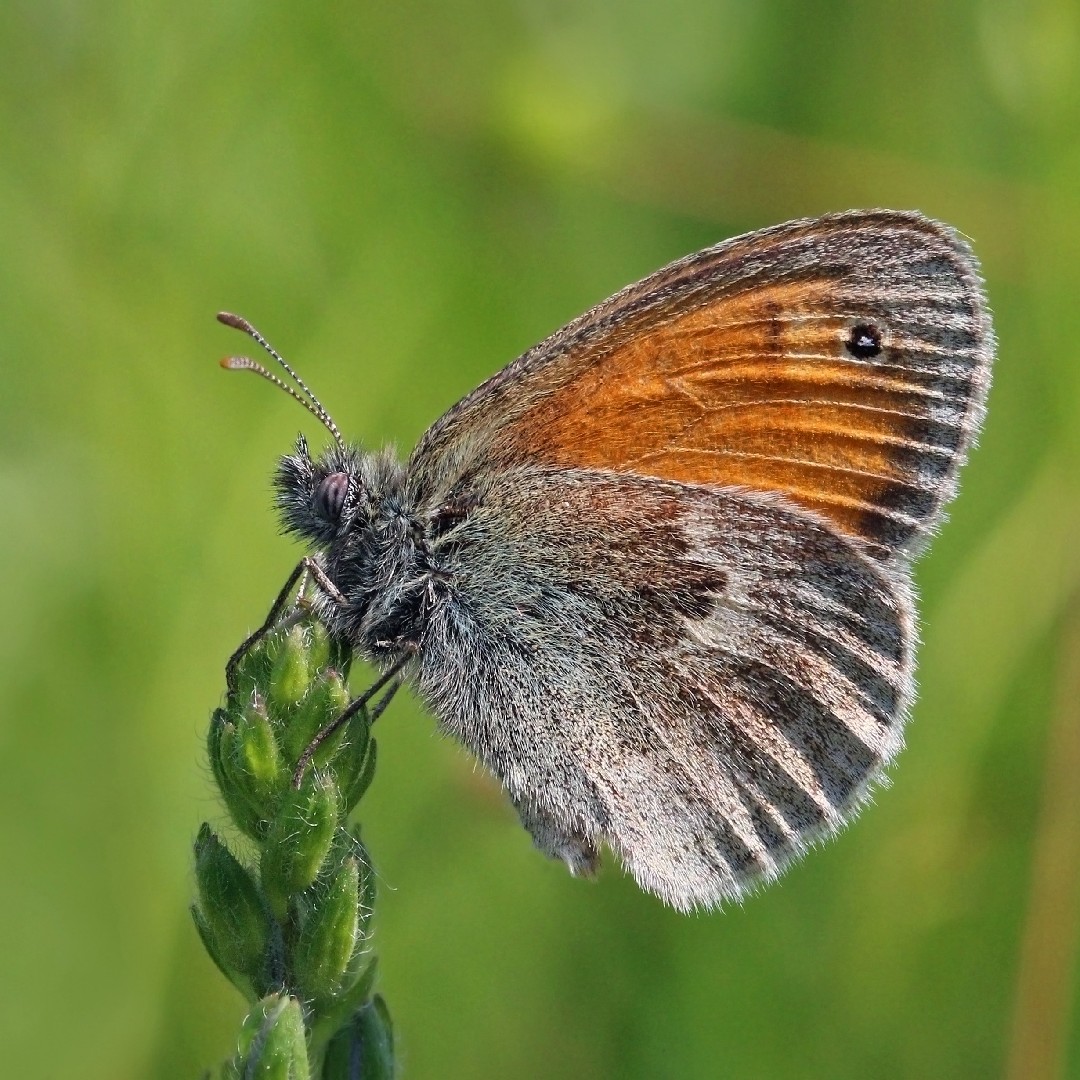
4. Small heath
It rests with closed wings when not in flight.
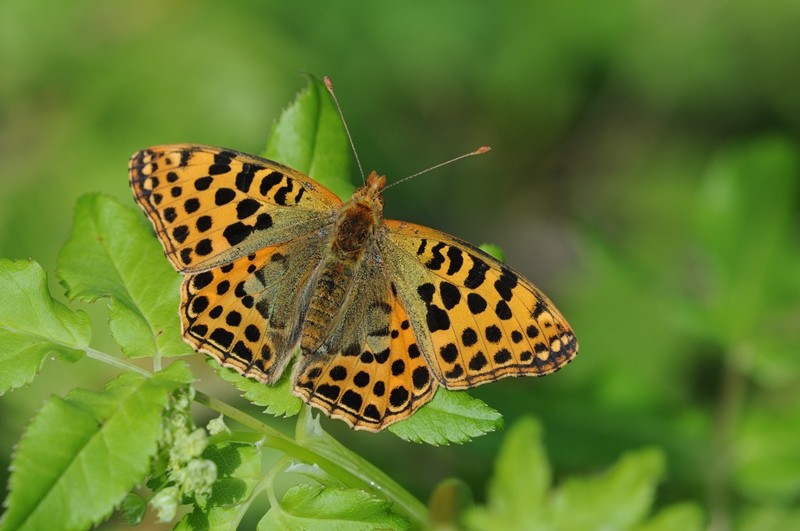
5. Queen of spain fritillary
Issoria lathonia is a medium-sized butterfly with a wingspan of 4 - 4.5 cm. The wings show a deep orange-violet background, with rounded black spots arranged in regular rows and suffused with greenish gray in the females. The underside of the hindwings is decorated with large pearly nacreous spots and it is crossed by a postdiscal row of black eyespots with pearly pupils. Some pearly spots also appear at the apex of the forewings. The caterpillar can reach a length of 3.5 cm. It is grayish brown, with black spots, and relatively short brown spines with white tip, and a double row of dorsal white streaks. The suspended chrysalis is dark brown, with a large white saddle-shaped stain and some smaller ones of the same color, resembling a bird's dropping. The imago is rather similar to Argynnis aglaja, Argynnis adippe and Brenthis daphne, which have the same orange color on the upperside of the wings, but show different markings and spots. Moreover, the underside of the hindwings does not have the large pearly spots characteristic of the queen of spain fritillary.
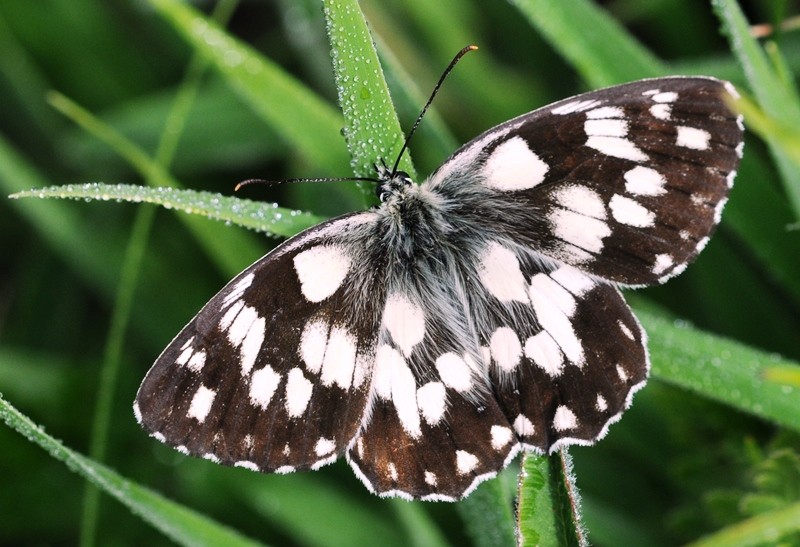
6. Marbled white
Melanargia galathea has a wingspan of 1.8–2.2 in. In these medium-sized butterflies the upper side of the wings is decorated with white and gray-black or dark brown markings, but it is always gray-black or dark brown checkered in the basal and distal areas. The underside is similar to the upper side but the drawings is light gray or light brown. On the underside of the hindwings is present a row of gray eye spots. The males and the females are quite similar, except that some females may have a yellowish nuance on the underside of the wings. The larvae are a lime-green colour, with a dark green line running down the middle of their back. The caterpillars are about 3 cm long. They are green or yellow with some lighter and darker narrow longitudinal lines. The head is always light brown.
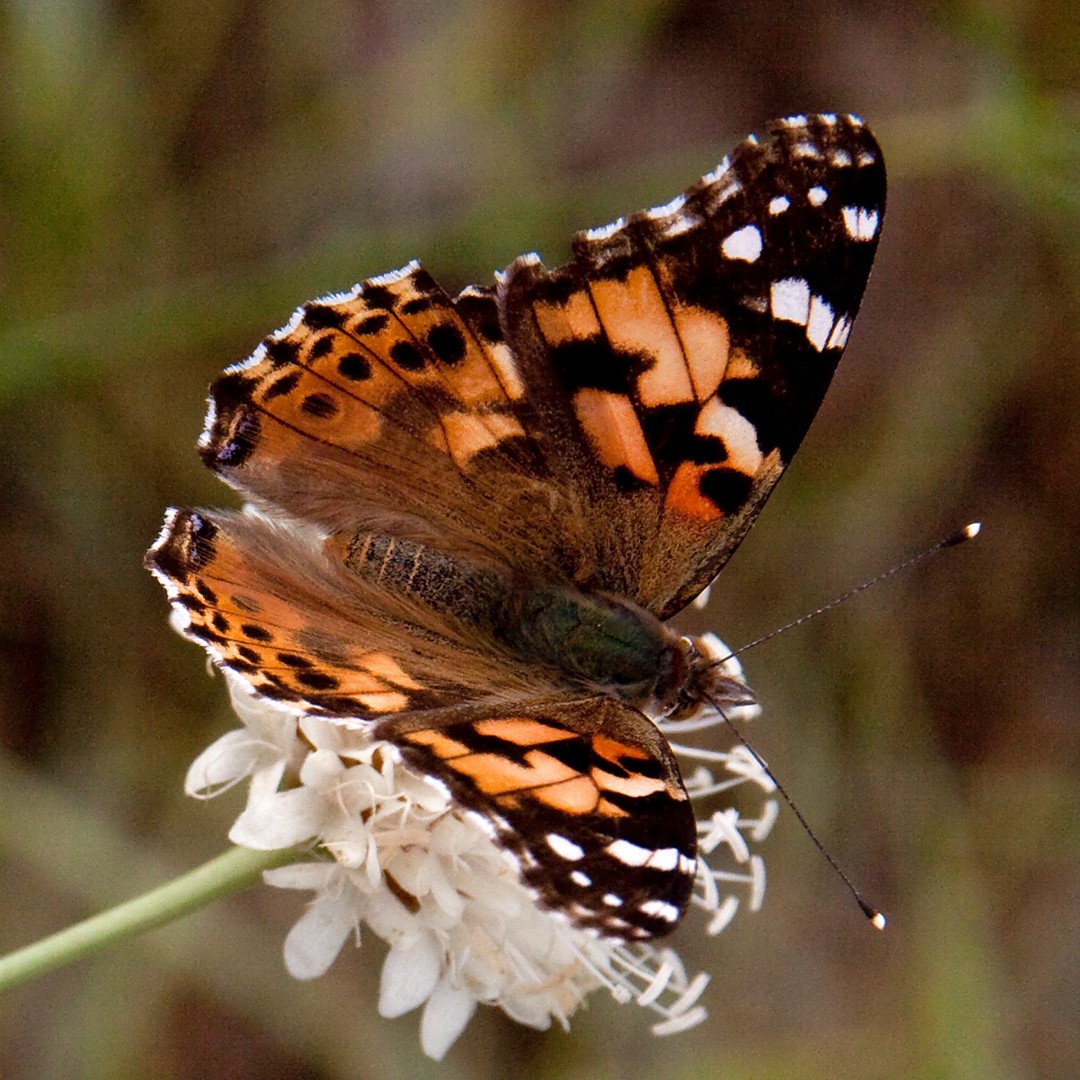
7. Painted lady
The painted lady is a migratory butterfly that spends part of the year in Northern Africa and then migrates to Europe during the warmer months. Although the adults feed on nectar from flowers, the larvae feed on the leaves of nettles and thistles.
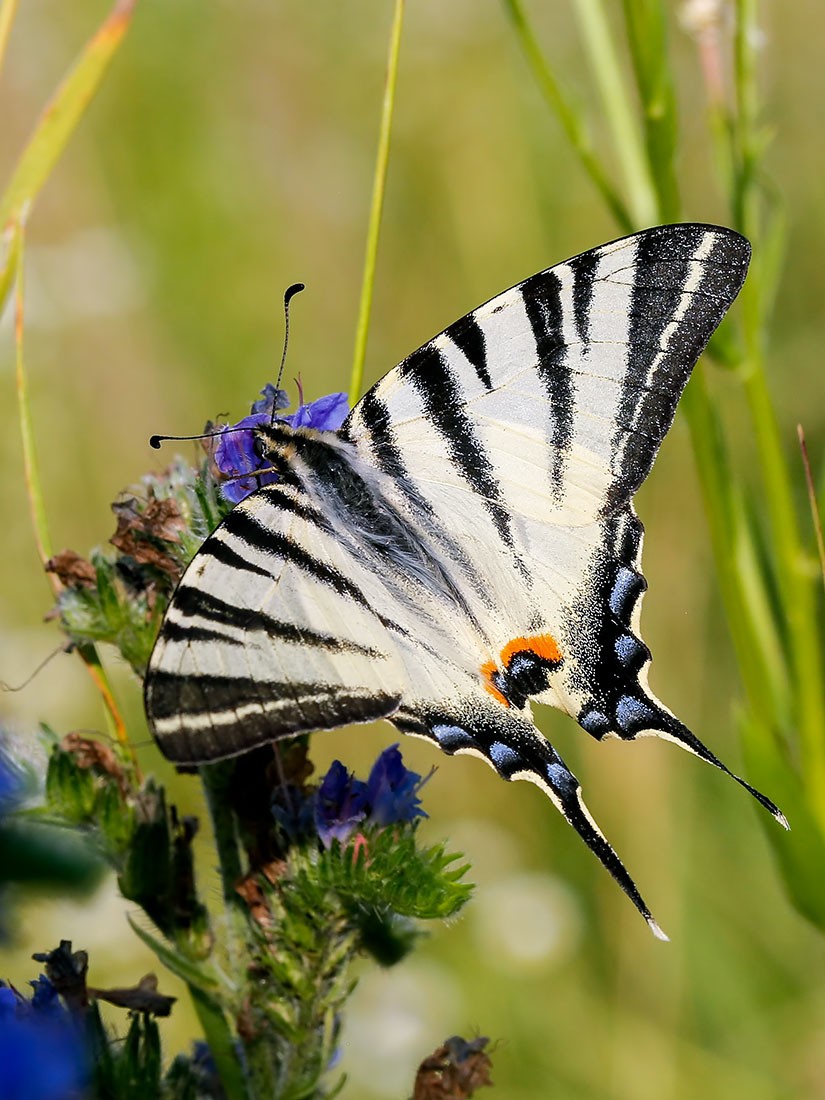
8. Scarce swallowtail
Its slow and floating flight pattern makes it easy to identify the scarce swallowtail as it soars over gardens, orchards, and scrublands. The butterfly has a large presence across Europe, the Middle East, and Asia. The adult lifespan is brief, only two or three weeks. Planting flowers like blackthorn can encourage the butterfly to visit a garden.
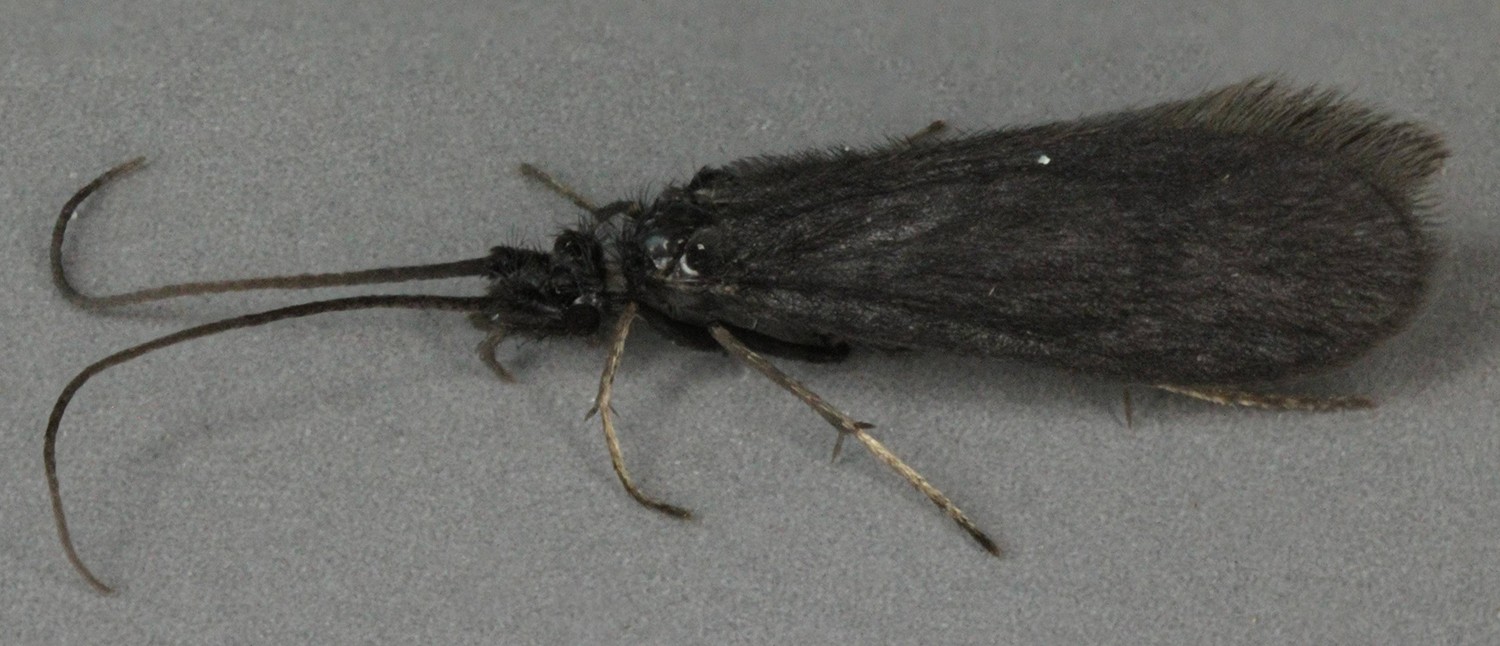
9. Beraea pullata
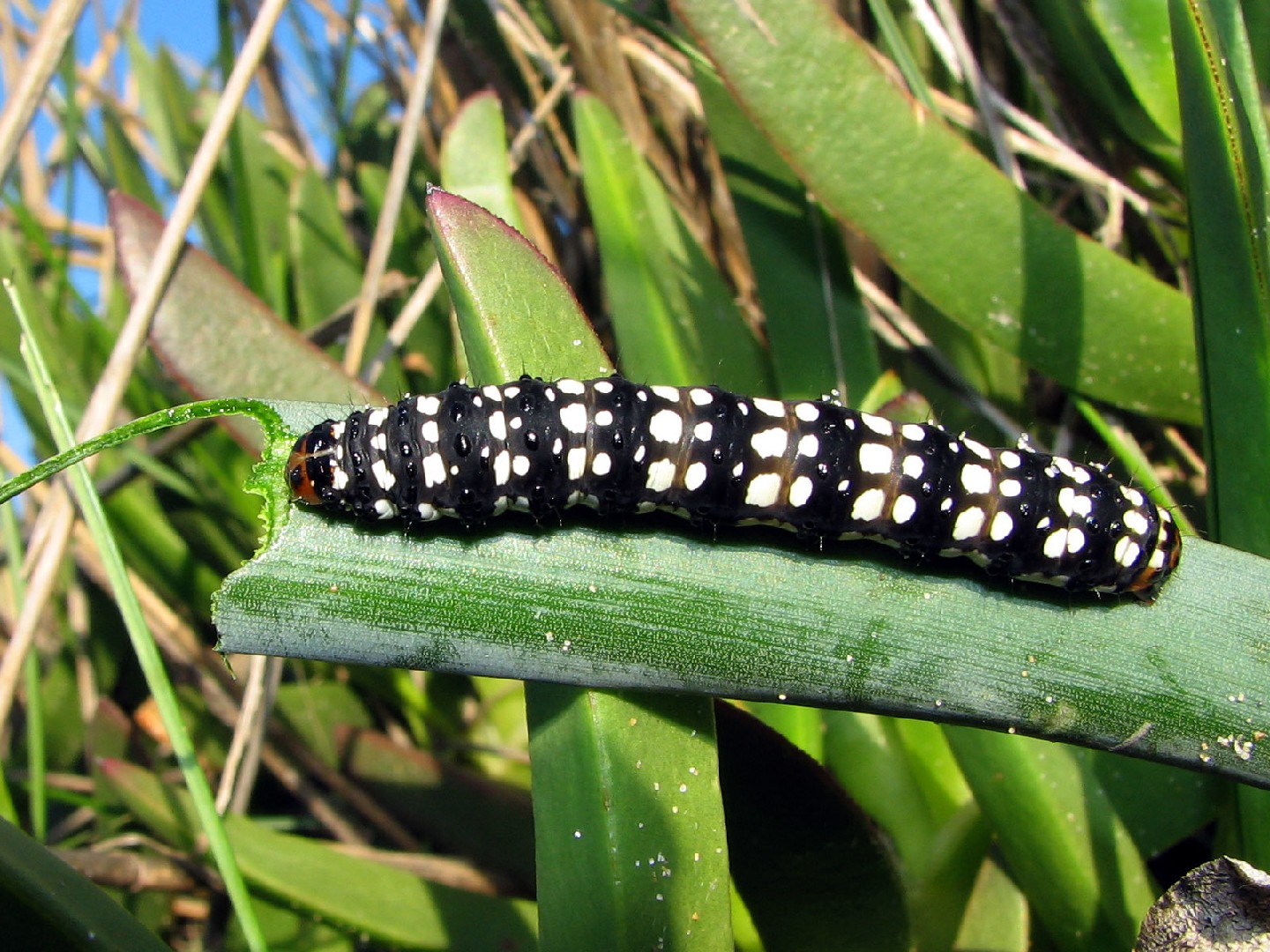
10. Lily borer
The wingspan of the moth is about 4 cm. Its head, thorax and forewings are very dark brown, but paler toward the wingtips. Sub-basal, median and postmedial indistinct waved lines are black. A curved submarginal ochreous line with ferrous colored lunuled found on each side of it. There is a marginal black lunule series. The hindwings are practically white. Tarsi bear black and white stripes.
More







