




Top 20 Most Common Insects in Gotland
Insects, with their distinguished features and diverse habitats, are an integral part of Gotland's ecosystem. The geography of Gotland deeply influences insect diversity, with factors such as climate and vegetation attracting different species. Insects play pivotal roles, both as pests and allies in agricultural cycles. It’s fascinating how Gotland's environments shape the insect community. Let’s explore the 20 most common insects in Gotland.

Most Common Insects
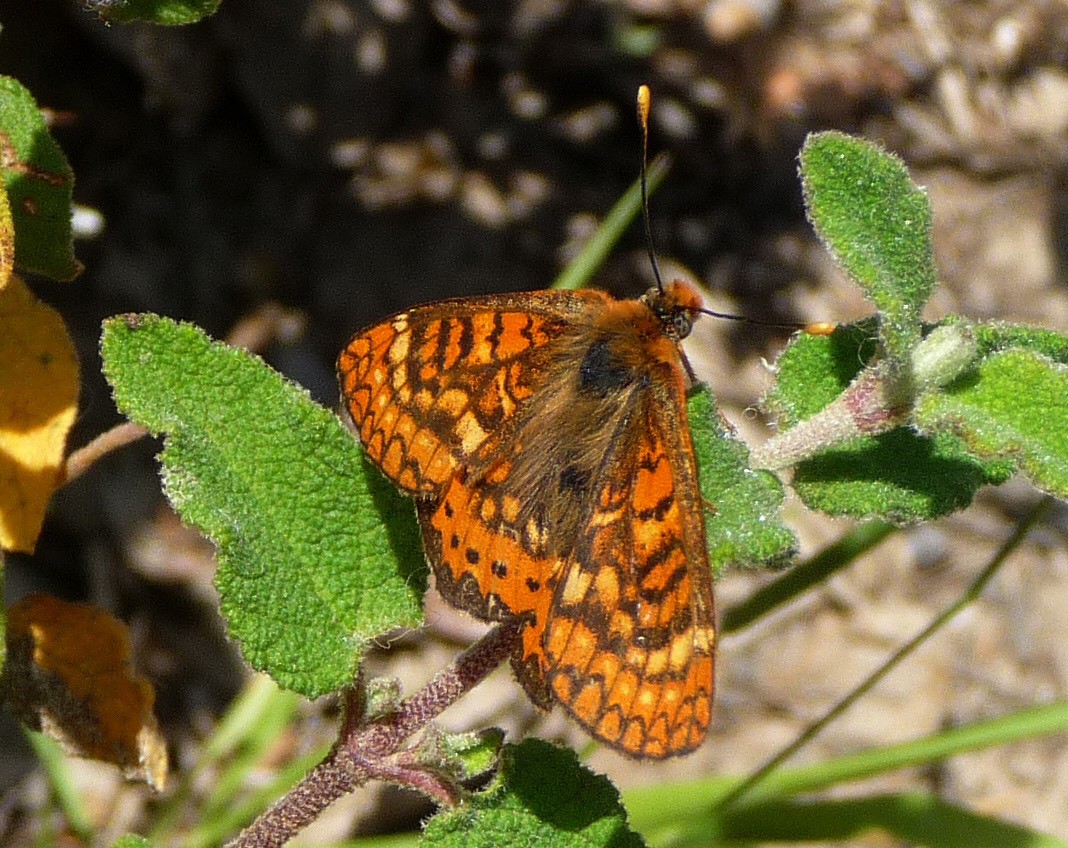
1. Marsh fritillary
Euphydryas aurinia has a wingspan of 30–42 millimetres (1.2–1.7 in) in males. The females are usually larger than the males, with a wingspan of 40–50 millimetres (1.6–2.0 in). These small butterflies are variable in markings and colouration, with many forms and subspecies. The adult butterflies usually show a chequered pattern of brown, orange, and yellow markings. Silver markings are present on the hindwing edge. The underside of the wings is patterned with yellow, orange, and brown without any silver colouration at all. The eggs are yellow, and easily identified because of the large batch size. The larvae are black. 
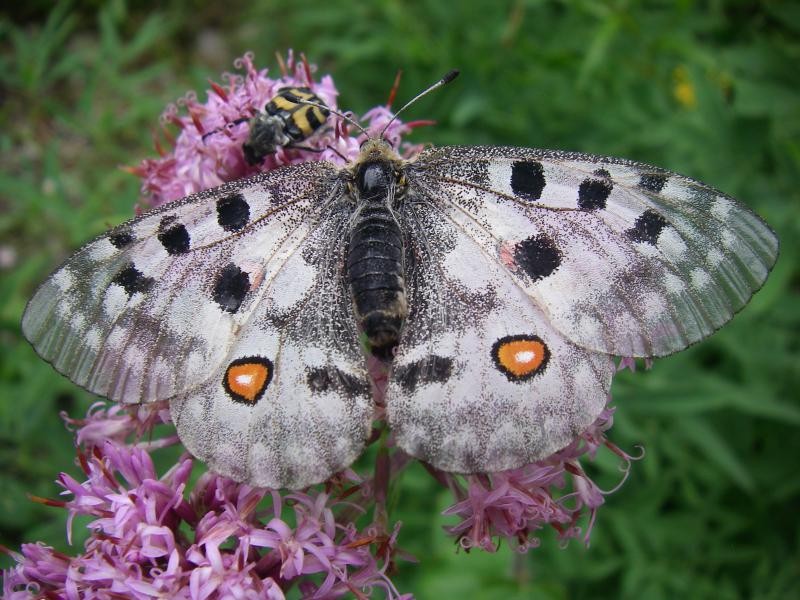
2. Apollo
Parnassius apollo has a wingspan of 6 - 9 cm in males, of 7 - 9 cm in females. The apollo butterfly shows a great deal of individual variation in the appearance, with an evident colour polymorphism. These very very large, beautiful and conspicuous white butterflies are decorated with five large black eyespots on the forewing and two bright red or sometimes orange eyespots on the hindwing. These striking red eyespots can vary in size and form depending on the location of the apollo butterfly, and the bright red colour often fades in the sun, causing the eyespots of older individuals to appear more orange. The wings are shiny, with slightly transparent edges, and some individuals are darker (sphragismelanistic); a general phenomenon common in many butterflies. The caterpillars of this species are velvety black with orange-red spots along the sides.
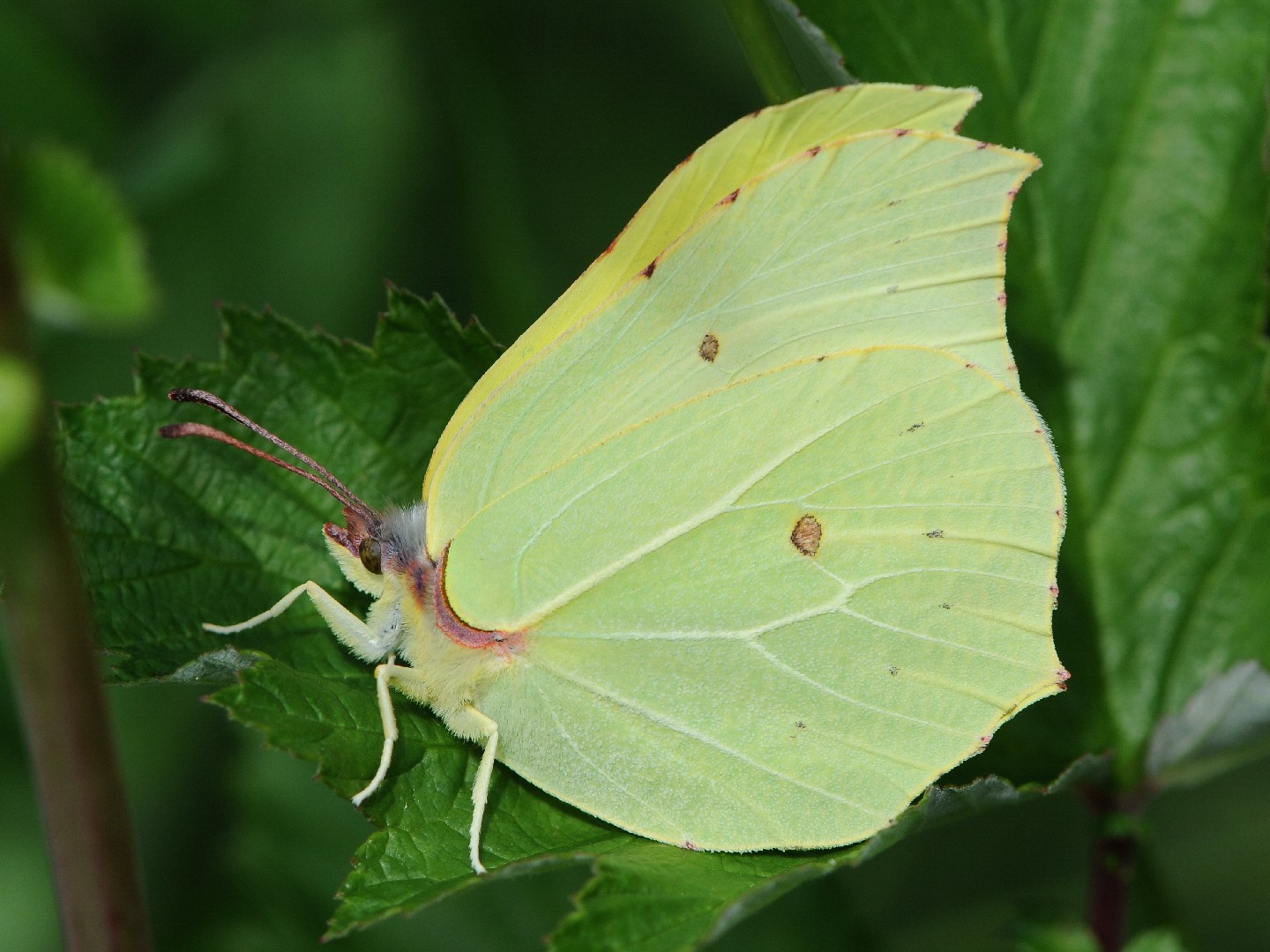
3. Common brimstone
Common brimstone (Gonepteryx rhamni) is an attractive species of butterfly; males display iridescence and have yellow wings, whereas females have white-green, non-iridescent wings. This species is wholly reliant on two species of buckthorn plant to lay its eggs. Consequently, the larvae consume large amounts of buckthorn.

4. Large blue
Large blue caterpillars grow to about half an inch (13 millimetres) in length, and spend up to 9 months before they undergo metamorphosis to a chrysalis to become a butterfly. Large blue butterflies are one of the largest in the family Lycaenidae, known as the gossamer-winged butterfly, with a wingspan of up to 2 inches (50.8 millimetres), and live only for a few weeks. The wings of the large blue butterfly are speckled with black dots.
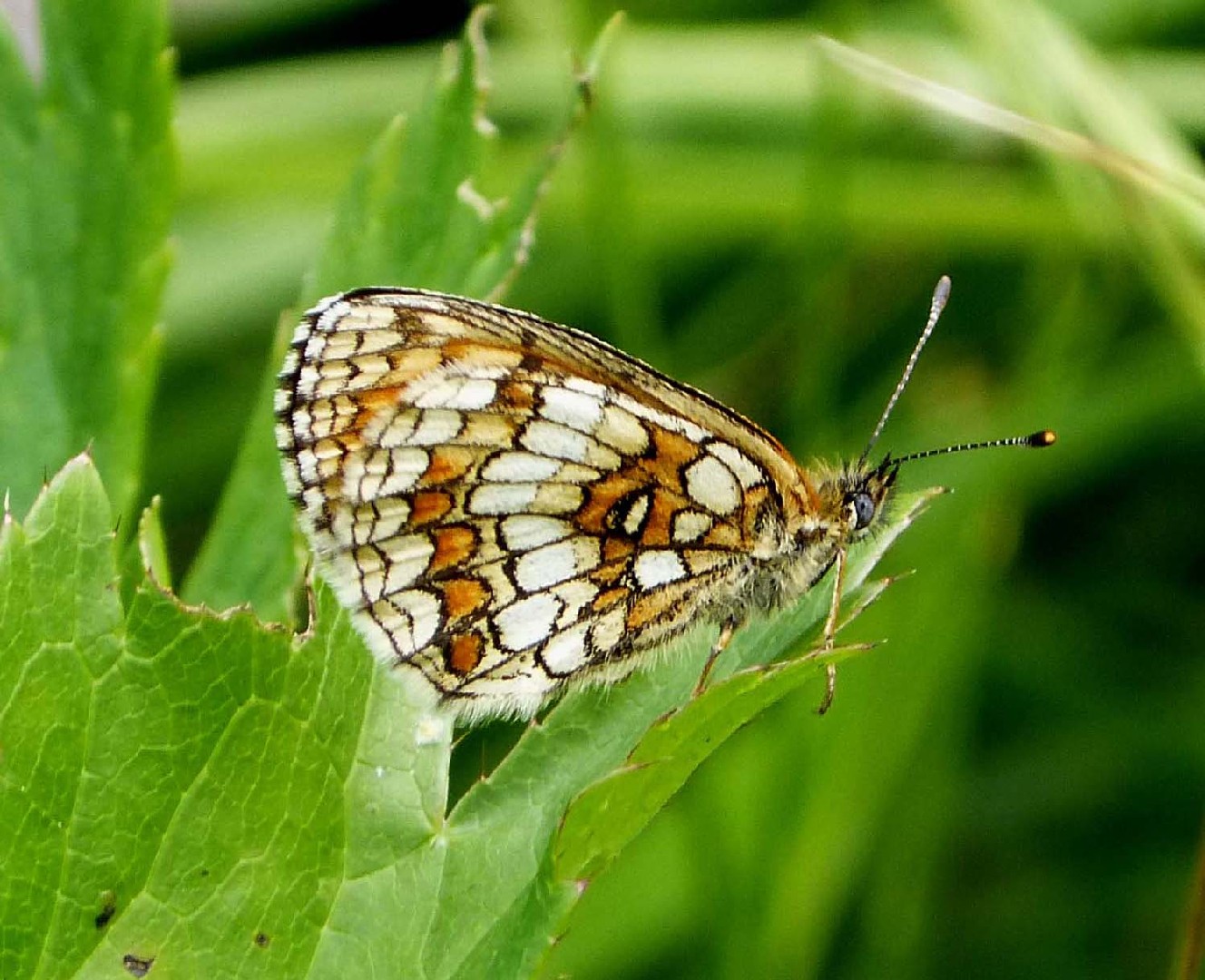
5. Heath fritillary
Heath fritillaries have a wingspan of 39–47 mm. The upperside is predominantly dark brown and orange brown, with the orange-brown spots delineated by dark brown (along and across the wing veins); there is a white fringe to the wings through which the dark brown extends. The upperside of the body is a similar dark brown to the colour on the wing, and the base of both wings is dark brown. The underside shows bands of red and (off-)white, again with each vein dark brown and each colour delineated by dark brown. The pattern of white spots at the base of the hindwing (visible at rest) is diagnostic for identification. These wing patterns are very similar to the appearance of Melitaea cinxia. However, the dark brown bands on underside of the wings are more distinct in the health fritillary than in M. cinxia.
6. Meadow brown
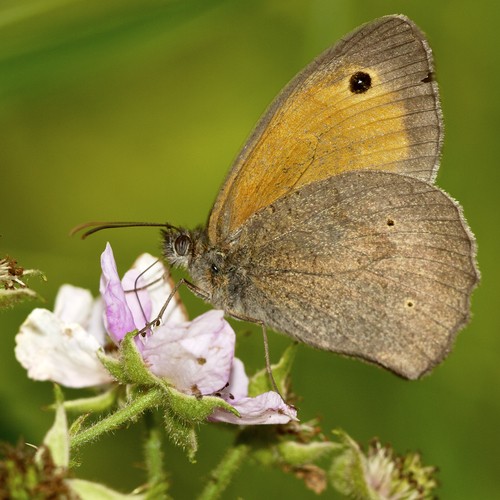
The meadow brown (Maniola jurtina) is similar to the Gatekeeper in the way that it rests with its wings open due to the "eye spots" on either end of its wings that ward off predators. While the color is a deep brown, the caterpillar form is a beautiful bright green with little, white hairs and a dark line leading down its back.
7. Woodland Brown
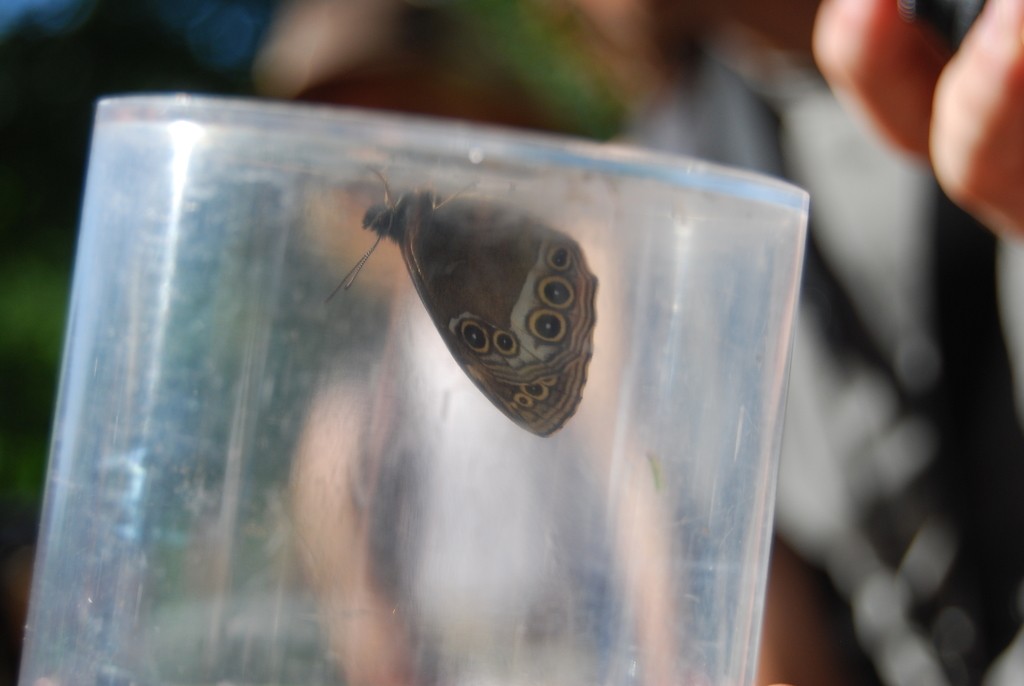
P. achine Scop. (= dejanira L.) (45 g). Dark brown: forewing with 5—6 eye-rings forming a chain, hindwing with 2—4 such rings. Underside proximally to the ocelli with a white distal band which is variable and may be so much reduced that the row of ocelli is placed within the ground-colour. Deviations in the band occur especially often in alpine specimens, though singly also in other places, ab. mendelensis Lowe being based on such variation. From West Europe throughout Central and North Europe, Siberia and North China to Japan, northward to Livonia. North Russia and Amurland. southward to Northern Italy. — In the east of the area there occur specimens with the eye-rings on the upperside enlarged, ab. achinoides Btl. (= eximia Stgr.). the specimens being moreover often of a brighter colour: but they fly together with individuals which are not distinguishable from European ones. — Larva green, with yellowish brown head.3 dark dorsal hues and pale double lateral stripe ; till May on Lolium, Poa, Triticum, etc. Pupa green, with angular head and a thoracic tubercle. The butterflies occur in woods of tall leaved trees, especially if there is a luxurious undergrowth, in June and July, the flight being dancing. They pitch on bushes, drink on damp places of the roads and imbibe the sap of wounded trees. Widely distributed in Europe, but sporadic and usually not very plentiful, being on the contrary extremely common in East Asia, assembling sometimes in swarms. They even occur in abundance on the islands near the Pacific coast (Yjezo, Askold). The males appear so much earlier than the males that they usually are already worn when the first females emerge. The species is widely distributed, but uncommon and local in continental Europe. Most of the suitable habitats for the species have been lost. The woodland brown may be found in warm openings of damp unmanaged mature forests.
8. Ringlet
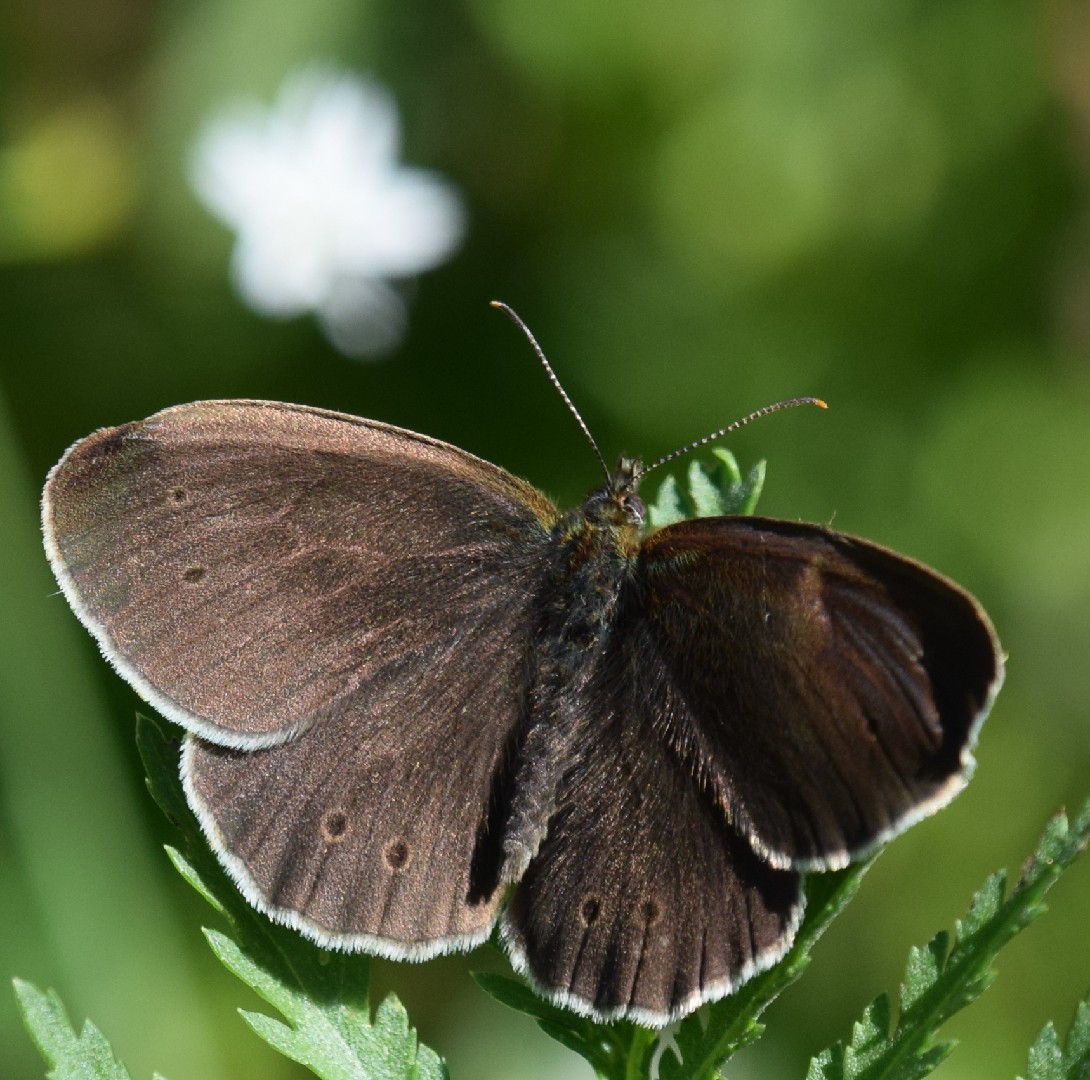
Aphantopus hyperantus is a medium-sized butterfly with a wingspan of up to 3.5 - 4 cm . The wing upper and lower sides are solid brown with small, yellowish-rimmed eyespots. The newly emerged ringlet has a velvety appearance and is almost black with a white fringe to the wings. The number and size of the eyespots is variable, they may be missing on the upper wing surface. The eggs are pale yellow when first laid, but become pale brown.The caterpillars are about 2.5 cm long. They are gray or light reddish brown and have dark, reddish brown and very fine dots. Dorsally there is a dark longitudinal line, which is widened at the segment boundaries. Toward the rear, this line is more intensely colored. The head is darker and has several faint longitudinal stripes.
9. Silver-washed fritillary
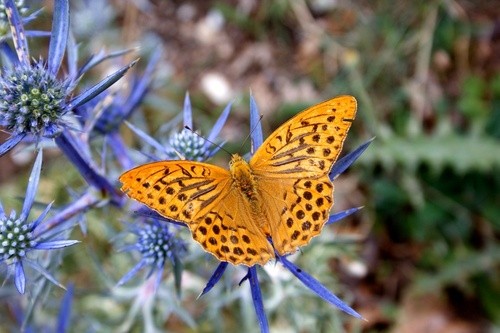
The silver-washed fritillary (Argynnis paphia) is a beautiful, orange butterfly that is covered in black spots. It earns the "silver-washed" portion of its name through silver streaks you can find running along with it. It produces a scent using "scales" that allows it to distinguish itself when females are trying to locate it.
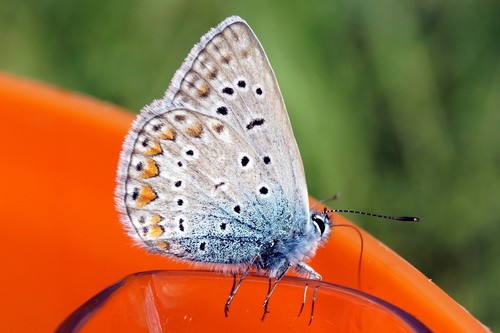
10. Common blue butterfly
Despite its common name, only male specimens of common blue butterfly (Polyommatus icarus) can accurately be described as blue; the females are predominately gray-brown, with only a dusting of blue and a scattering of orange spots. The adults live for only three weeks before dying.
More







